[English] 日本語
Yorodumi Papers
- Database of articles cited by EMDB/PDB/SASBDB data -

+
Search query

Keywords
Structure methods
Author
Journal
IF

-
Structure paper

TitleDeFrND: detergent-free reconstitution into native nanodiscs with designer membrane scaffold peptides.
Journal, issue, pagesNat Commun, Vol. 16, Issue 1, Page 7973, Year 2025
Publish dateAug 26, 2025
AuthorsQian Ren / Jing Wang / Vinay Idikuda / Shanwen Zhang / Jeehae Shin / W Grant Ludlam / Luis M Real Hernandez / Sara Zdancewicz / Alex J B Kreutzberger / Hucheng Chang / Volker Kiessling / Lukas K Tamm / Ahmad Jomaa / Ilya Levental / Kirill Martemyanov / Baron Chanda / Huan Bao /
PubMed AbstractMembrane scaffold protein-based nanodiscs have facilitated unprecedented structural and biophysical analysis of membrane proteins in a near-native lipid environment. However, successful ...Membrane scaffold protein-based nanodiscs have facilitated unprecedented structural and biophysical analysis of membrane proteins in a near-native lipid environment. However, successful reconstitution of membrane proteins in nanodiscs requires prior solubilization and purification in detergents, which may impact their physiological structure and function. Furthermore, the detergent-mediated reconstitution of nanodiscs is unlikely to recapitulate the precise composition or asymmetry of native membranes. To circumvent this fundamental limitation of traditional nanodisc technology, we herein describe the development of membrane-solubilizing peptides to directly extract membrane proteins from native cell membranes into nanoscale discoids. By systematically protein engineering and screening, we create a class of chemically modified Apolipoprotein-A1 mimetic peptides to enable the formation of detergent-free nanodiscs with high efficiency. Nanodiscs generated with these engineered membrane scaffold peptides are suitable for obtaining high-resolution structures using single-particle cryo-EM with native lipids. To further highlight the versatility of our approach, we directly extract a sampling of membrane signaling proteins with their surrounding native membranes for biochemical and biophysical interrogations.
External linksNat Commun / PubMed:40858559 / PubMed Central
MethodsEM (single particle)
Resolution3.26 - 3.51 Å
Structure data

EMDB-44435, PDB-9bcr:
Cryo-EM structure of a bacterial prototype ATP-binding cassette transporter MalFGK2.
Method: EM (single particle) / Resolution: 3.26 Å

EMDB-49659, PDB-9nqj:
Cryo-EM structure of a bacterial prototype ATP-binding cassette transporter MalFGK2.
Method: EM (single particle) / Resolution: 3.34 Å

EMDB-49901, PDB-9nxc:
Cryo-EM structure of a bacterial prototype ATP-binding cassette transporter MalFGK2.
Method: EM (single particle) / Resolution: 3.51 Å

Chemicals

ChemComp-MG:
Unknown entry

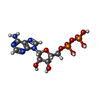
ChemComp-ADP:
ADENOSINE-5'-DIPHOSPHATE / ADP, energy-carrying molecule*YM

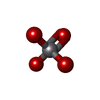
ChemComp-VO4:
VANADATE ION

Source
  • escherichia coli k-12 (bacteria)
  • escherichia coli (E. coli)
KeywordsTRANSPORT PROTEIN / bacterial prototype ATP-binding cassette transporter

+
About Yorodumi Papers

-
News

-
Feb 9, 2022. New format data for meta-information of EMDB entries

New format data for meta-information of EMDB entries

  • Version 3 of the EMDB header file is now the official format.
  • The previous official version 1.9 will be removed from the archive.

Related info.:EMDB header

External links:wwPDB to switch to version 3 of the EMDB data model

-
Aug 12, 2020. Covid-19 info

Covid-19 info

URL: https://pdbj.org/emnavi/covid19.php

New page: Covid-19 featured information page in EM Navigator.

Related info.:Covid-19 info / Mar 5, 2020. Novel coronavirus structure data

+
Mar 5, 2020. Novel coronavirus structure data

Novel coronavirus structure data

Related info.:Yorodumi Speices / Aug 12, 2020. Covid-19 info

External links:COVID-19 featured content - PDBj / Molecule of the Month (242):Coronavirus Proteases

+
Jan 31, 2019. EMDB accession codes are about to change! (news from PDBe EMDB page)

EMDB accession codes are about to change! (news from PDBe EMDB page)

  • The allocation of 4 digits for EMDB accession codes will soon come to an end. Whilst these codes will remain in use, new EMDB accession codes will include an additional digit and will expand incrementally as the available range of codes is exhausted. The current 4-digit format prefixed with “EMD-” (i.e. EMD-XXXX) will advance to a 5-digit format (i.e. EMD-XXXXX), and so on. It is currently estimated that the 4-digit codes will be depleted around Spring 2019, at which point the 5-digit format will come into force.
  • The EM Navigator/Yorodumi systems omit the EMD- prefix.

Related info.:Q: What is EMD? / ID/Accession-code notation in Yorodumi/EM Navigator

External links:EMDB Accession Codes are Changing Soon! / Contact to PDBj

+
Jul 12, 2017. Major update of PDB

Major update of PDB

  • wwPDB released updated PDB data conforming to the new PDBx/mmCIF dictionary.
  • This is a major update changing the version number from 4 to 5, and with Remediation, in which all the entries are updated.
  • In this update, many items about electron microscopy experimental information are reorganized (e.g. em_software).
  • Now, EM Navigator and Yorodumi are based on the updated data.

External links:wwPDB Remediation / Enriched Model Files Conforming to OneDep Data Standards Now Available in the PDB FTP Archive

-
Yorodumi Papers

Database of articles cited by EMDB/PDB/SASBDB data

  • Database of articles cited by EMDB, PDB, and SASBDB entries
  • Using PubMed data

Related info.:EMDB / PDB / SASBDB / Yorodumi / EMN Papers / Changes in new EM Navigator and Yorodumi

Read more