[English] 日本語
Yorodumi Papers
- Database of articles cited by EMDB/PDB/SASBDB data -

+
Search query

Keywords
Structure methods
Author
Journal
IF

-
Structure paper

TitleArchaeal and eukaryotic MCM rings sequentially melt DNA for replication initiation.
Journal, issue, pagesNat Commun, Vol. 17, Issue 1, Year 2026
Publish dateMar 31, 2026
AuthorsSanaz Rasouli / Alexander Myasnikov / Eric J Enemark /
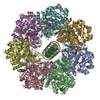
PubMed AbstractDNA replication initiation requires local melting of fully base-paired DNA for a helicase to gain a foothold and initiate processive DNA unwinding. In eukaryotes and archaea, the helicase engine is ...DNA replication initiation requires local melting of fully base-paired DNA for a helicase to gain a foothold and initiate processive DNA unwinding. In eukaryotes and archaea, the helicase engine is the hexameric ring minichromosome maintenance (MCM) complex. In eukaryotes, a defined biochemical sequence assembles two Cdc45-MCM-GINS (CMG) complexes that provide limited DNA unwinding as the species that immediately precedes extensive unwinding. A prior structure revealed how MCM subunits interact with this form of DNA, but the atomic progression from undistorted DNA to this melted DNA species is unknown. Here, we present a sequential DNA melting mechanism determined by snapshots of an archaeal MCM ring with DNA in varying degrees of melting. In this mechanism, successive ATP-binding at MCM ATPase sites drives sequential discrete DNA melting steps mediated a specific MCM aromatic residue. Analysis of eukaryotic structures shows loaded MCM rings principally adopt only two molecular arrangements at the ATPase: one that does not melt DNA and one tuned to melt DNA with equivalent aromatic residues, indicating a universal sequential mechanism melts DNA in archaea and eukaryotes for replication initiation.
External linksNat Commun / PubMed:41916983 / PubMed Central
MethodsEM (single particle)
Resolution2.45 - 4.04 Å
Structure data

EMDB-49806, PDB-9nuh:
SsoPfMCM:DNA class 1a from merged particles
Method: EM (single particle) / Resolution: 2.92 Å

EMDB-49807, PDB-9nui:
SsoPfMCM:DNA class 1b from merged particles
Method: EM (single particle) / Resolution: 3.24 Å

EMDB-49808, PDB-9nuj:
SsoPfMCM:DNA class 1c from merged particles
Method: EM (single particle) / Resolution: 3.44 Å

EMDB-49809, PDB-9nuk:
SsoPfMCM:DNA class 2a from merged particles
Method: EM (single particle) / Resolution: 2.7 Å

EMDB-49810, PDB-9nul:
SsoPfMCM:DNA class 2b from merged particles
Method: EM (single particle) / Resolution: 2.5 Å

EMDB-49811, PDB-9num:
SsoPfMCM:DNA class 3 from merged particles
Method: EM (single particle) / Resolution: 3.67 Å

EMDB-49812, PDB-9nun:
SsoPfMCM:DNA class 1a from DNA 1
Method: EM (single particle) / Resolution: 3.36 Å

EMDB-49813, PDB-9nuo:
SsoPfMCM:DNA class 1b from DNA 1
Method: EM (single particle) / Resolution: 3.58 Å

EMDB-49814, PDB-9nup:
SsoPfMCM:DNA class 1c from DNA 1
Method: EM (single particle) / Resolution: 3.9 Å

EMDB-49815, PDB-9nuq:
SsoPfMCM:DNA class 2a from DNA 1
Method: EM (single particle) / Resolution: 3.13 Å

EMDB-49816, PDB-9nur:
SsoPfMCM:DNA class 2b from DNA 1
Method: EM (single particle) / Resolution: 2.99 Å

EMDB-49817, PDB-9nus:
SsoPfMCM:DNA class 3 from DNA 1
Method: EM (single particle) / Resolution: 4.04 Å

EMDB-49818, PDB-9nut:
SsoPfMCM:DNA class 1a from DNA 2
Method: EM (single particle) / Resolution: 2.93 Å

EMDB-49819, PDB-9nuu:
SsoPfMCM:DNA class 1b from DNA 2
Method: EM (single particle) / Resolution: 3.38 Å

EMDB-49820, PDB-9nuv:
SsoPfMCM:DNA class 1c from DNA 2
Method: EM (single particle) / Resolution: 3.51 Å

EMDB-49821, PDB-9nuw:
SsoPfMCM:DNA class 2a from DNA 2
Method: EM (single particle) / Resolution: 2.65 Å

EMDB-49822, PDB-9nux:
SsoPfMCM:DNA class 2b from DNA 2
Method: EM (single particle) / Resolution: 2.45 Å

EMDB-49823, PDB-9nuy:
SsoPfMCM:DNA class 3 from DNA 2
Method: EM (single particle) / Resolution: 3.52 Å

Chemicals

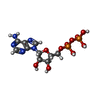
ChemComp-ADP:
ADENOSINE-5'-DIPHOSPHATE / ADP, energy-carrying molecule*YM

ChemComp-MG:
Unknown entry

ChemComp-ZN:
Unknown entry

ChemComp-HOH:
WATER

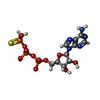
ChemComp-AGS:
PHOSPHOTHIOPHOSPHORIC ACID-ADENYLATE ESTER / ATP-gamma-S, energy-carrying molecule analogue*YM

Source
  • saccharolobus solfataricus p2 (archaea)

  • pyrococcus furiosus dsm 3638 (archaea)
  • synthetic construct (others)
KeywordsREPLICATION / HYDROLASE/DNA / DNA replication / helicase / MCM / HYDROLASE- DNA complex / HYDROLASE-DNA complex

+
About Yorodumi Papers

-
News

-
Feb 9, 2022. New format data for meta-information of EMDB entries

New format data for meta-information of EMDB entries

  • Version 3 of the EMDB header file is now the official format.
  • The previous official version 1.9 will be removed from the archive.

Related info.:EMDB header

External links:wwPDB to switch to version 3 of the EMDB data model

-
Aug 12, 2020. Covid-19 info

Covid-19 info

URL: https://pdbj.org/emnavi/covid19.php

New page: Covid-19 featured information page in EM Navigator.

Related info.:Covid-19 info / Mar 5, 2020. Novel coronavirus structure data

+
Mar 5, 2020. Novel coronavirus structure data

Novel coronavirus structure data

Related info.:Yorodumi Speices / Aug 12, 2020. Covid-19 info

External links:COVID-19 featured content - PDBj / Molecule of the Month (242):Coronavirus Proteases

+
Jan 31, 2019. EMDB accession codes are about to change! (news from PDBe EMDB page)

EMDB accession codes are about to change! (news from PDBe EMDB page)

  • The allocation of 4 digits for EMDB accession codes will soon come to an end. Whilst these codes will remain in use, new EMDB accession codes will include an additional digit and will expand incrementally as the available range of codes is exhausted. The current 4-digit format prefixed with “EMD-” (i.e. EMD-XXXX) will advance to a 5-digit format (i.e. EMD-XXXXX), and so on. It is currently estimated that the 4-digit codes will be depleted around Spring 2019, at which point the 5-digit format will come into force.
  • The EM Navigator/Yorodumi systems omit the EMD- prefix.

Related info.:Q: What is EMD? / ID/Accession-code notation in Yorodumi/EM Navigator

External links:EMDB Accession Codes are Changing Soon! / Contact to PDBj

+
Jul 12, 2017. Major update of PDB

Major update of PDB

  • wwPDB released updated PDB data conforming to the new PDBx/mmCIF dictionary.
  • This is a major update changing the version number from 4 to 5, and with Remediation, in which all the entries are updated.
  • In this update, many items about electron microscopy experimental information are reorganized (e.g. em_software).
  • Now, EM Navigator and Yorodumi are based on the updated data.

External links:wwPDB Remediation / Enriched Model Files Conforming to OneDep Data Standards Now Available in the PDB FTP Archive

-
Yorodumi Papers

Database of articles cited by EMDB/PDB/SASBDB data

  • Database of articles cited by EMDB, PDB, and SASBDB entries
  • Using PubMed data

Related info.:EMDB / PDB / SASBDB / Yorodumi / EMN Papers / Changes in new EM Navigator and Yorodumi

Read more