 Movie
Movie Controller
 Structure viewers
 About Yorodumi Papers


+Search query
-Structure paper
| Title | Get4/5-mediated remodeling of Get3's substrate-binding chamber: Insights into tail-anchored protein targeting by the GET pathway. |
|---|---|
| Journal, issue, pages | J Biol Chem, Vol. 301, Issue 10, Page 110667, Year 2025 |
| Publish date | Sep 1, 2025 |
 Authors Authors | Diego Granados-Villanueva / Andrew Rossow / Kelly H Kim /  |
| PubMed Abstract | The Guided Entry of Tail-Anchored Proteins (GET) pathway ensures accurate targeting of Tail-Anchored proteins (TAs)-a diverse class of membrane proteins-to the endoplasmic reticulum (ER) membrane. In ...The Guided Entry of Tail-Anchored Proteins (GET) pathway ensures accurate targeting of Tail-Anchored proteins (TAs)-a diverse class of membrane proteins-to the endoplasmic reticulum (ER) membrane. In yeast, newly synthesized TAs are captured by Sgt2 and transferred to Get3 for delivery to the ER, where they undergo subsequent membrane insertion. Efficient and protected handoff of hydrophobic TAs from Sgt2 to Get3 is facilitated by the Get4/5 complex, which is thought to act as a scaffold to position TA-bound Sgt2 and Get3 in proximity while trapping Get3 in an ATP-bound conformation necessary for TA binding. To define the molecular basis for this process, we determined the cryo-EM structure of the Saccharomyces cerevisiae Get3-Get4/5 complex at 3.2 Å resolution. Our structure shows that Get4/5 remodels Get3's TA-binding chamber by unfolding helices that form the lateral walls of the chamber. We termed this region the "lateral gate," as its helix-to-coil transition makes the TA-binding chamber more solvent accessible. Molecular dynamics simulations highlighted the flexibility of the lateral gate, indicating it is structurally dynamic and prone to conformational changes. Mutagenesis studies showed that the lateral gate residues influence both the binding affinity of Get3 for Get4/5 and its ATPase activity. Additionally, our cryo-EM map shows that the Sgt2-binding domain of Get5 is positioned near the lateral gate opening of Get3's TA-binding chamber. Based on these findings, we propose a model in which Get4/5 opens Get3's TA-binding chamber to form a lateral opening, enabling protected, lateral transfer of TAs from Sgt2 to Get3. |
 External links External links | J Biol Chem / PubMed:40902977 / PubMed Central |
| Methods | EM (single particle) |
| Resolution | 3.19 Å |
| Structure data | EMDB-49743, PDB-9ns5: |
| Chemicals |  ChemComp-ZN: 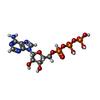 ChemComp-ATP:  ChemComp-MG: |
| Source |
|
 Keywords Keywords | CHAPERONE / membrane protein targeting / ATPase / protein complex |


 Saccharomyces cerevisiae (brewer's yeast)