[English] 日本語
Yorodumi Papers
- Database of articles cited by EMDB/PDB/SASBDB data -

+
Search query

Keywords
Structure methods
Author
Journal
IF

-
Structure paper

TitleLetA defines a structurally distinct transporter family.
Journal, issue, pagesNature, Year 2026
Publish dateJan 21, 2026
AuthorsCristina C Santarossa / Yupeng Li / Sara Yousef / Hale S Hasdemir / Carlos C Rodriguez / Max A B Haase / Minkyung Baek / Nicolas Coudray / John G Pavek / Kimber N Focke / Annika L Silverberg / Carmelita Bautista / Johannes T-H Yeh / Michael T Marty / David Baker / Emad Tajkhorshid / Damian C Ekiert / Gira Bhabha /
PubMed AbstractMembrane transport proteins translocate diverse cargos, ranging from small sugars to entire proteins, across cellular membranes. A few structurally distinct protein families have been described that ...Membrane transport proteins translocate diverse cargos, ranging from small sugars to entire proteins, across cellular membranes. A few structurally distinct protein families have been described that account for most of the known membrane transport processes. However, many membrane proteins with predicted transporter functions remain uncharacterized. Here we determined the structure of Escherichia coli LetAB, a phospholipid transporter involved in outer membrane integrity, and found that LetA adopts a distinct architecture that is structurally and evolutionarily unrelated to known transporter families. LetA localizes to the inner membrane, where it is poised to load lipids into its binding partner, LetB, a mammalian cell entry (MCE) protein that forms an approximately 225 Å long tunnel for lipid transport across the cell envelope. Unexpectedly, the LetA transmembrane domains adopt a fold that is evolutionarily related to the eukaryotic tetraspanin family of membrane proteins, including transmembrane AMPA receptor regulatory proteins (TARPs) and claudins. Through a combination of deep mutational scanning, molecular dynamics simulations, AlphaFold-predicted alternative states and functional studies, we present a model for how the LetA-like family of membrane transporters facilitates the transport of lipids across the bacterial cell envelope.
External linksNature / PubMed:41565823
MethodsEM (single particle)
Resolution3.5 Å
Structure data

EMDB-49148: Intermembrane lipid transport complex LetAB from Escherichia coli (Crosslinked, Composite Map 1)
PDB-9n8w: Intermembrane lipid transport complex LetAB from Escherichia coli (Crosslinked, Composite model corresponding to Map 1)
Method: EM (single particle) / Resolution: 3.5 Å

EMDB-49152: Intermembrane lipid transport complex LetAB from Escherichia coli (Composite Map 2)
PDB-9n8x: Intermembrane lipid transport complex LetAB from Escherichia coli (Composite model corresponding to Map 2)
Method: EM (single particle) / Resolution: 3.5 Å

Chemicals

ChemComp-ZN:
Unknown entry

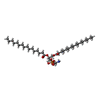
ChemComp-PEF:
DI-PALMITOYL-3-SN-PHOSPHATIDYLETHANOLAMINE / phospholipid*YM

Source
  • escherichia coli (E. coli)
  • escherichia coli str. k-12 substr. mg1655 (bacteria)
KeywordsLIPID TRANSPORT / Lipid transporter / Outer membrane integrity / MCE system / Metal-binding protein / Intermembrane complex

+
About Yorodumi Papers

-
News

-
Feb 9, 2022. New format data for meta-information of EMDB entries

New format data for meta-information of EMDB entries

  • Version 3 of the EMDB header file is now the official format.
  • The previous official version 1.9 will be removed from the archive.

Related info.:EMDB header

External links:wwPDB to switch to version 3 of the EMDB data model

-
Aug 12, 2020. Covid-19 info

Covid-19 info

URL: https://pdbj.org/emnavi/covid19.php

New page: Covid-19 featured information page in EM Navigator.

Related info.:Covid-19 info / Mar 5, 2020. Novel coronavirus structure data

+
Mar 5, 2020. Novel coronavirus structure data

Novel coronavirus structure data

Related info.:Yorodumi Speices / Aug 12, 2020. Covid-19 info

External links:COVID-19 featured content - PDBj / Molecule of the Month (242):Coronavirus Proteases

+
Jan 31, 2019. EMDB accession codes are about to change! (news from PDBe EMDB page)

EMDB accession codes are about to change! (news from PDBe EMDB page)

  • The allocation of 4 digits for EMDB accession codes will soon come to an end. Whilst these codes will remain in use, new EMDB accession codes will include an additional digit and will expand incrementally as the available range of codes is exhausted. The current 4-digit format prefixed with “EMD-” (i.e. EMD-XXXX) will advance to a 5-digit format (i.e. EMD-XXXXX), and so on. It is currently estimated that the 4-digit codes will be depleted around Spring 2019, at which point the 5-digit format will come into force.
  • The EM Navigator/Yorodumi systems omit the EMD- prefix.

Related info.:Q: What is EMD? / ID/Accession-code notation in Yorodumi/EM Navigator

External links:EMDB Accession Codes are Changing Soon! / Contact to PDBj

+
Jul 12, 2017. Major update of PDB

Major update of PDB

  • wwPDB released updated PDB data conforming to the new PDBx/mmCIF dictionary.
  • This is a major update changing the version number from 4 to 5, and with Remediation, in which all the entries are updated.
  • In this update, many items about electron microscopy experimental information are reorganized (e.g. em_software).
  • Now, EM Navigator and Yorodumi are based on the updated data.

External links:wwPDB Remediation / Enriched Model Files Conforming to OneDep Data Standards Now Available in the PDB FTP Archive

-
Yorodumi Papers

Database of articles cited by EMDB/PDB/SASBDB data

  • Database of articles cited by EMDB, PDB, and SASBDB entries
  • Using PubMed data

Related info.:EMDB / PDB / SASBDB / Yorodumi / EMN Papers / Changes in new EM Navigator and Yorodumi

Read more