 Movie
Movie Controller
 Structure viewers
 About Yorodumi Papers


+Search query
-Structure paper
| Title | Structural and Functional Characterization of Porcine Adeno-Associated Viruses. |
|---|---|
| Journal, issue, pages | Viruses, Vol. 17, Issue 9, Year 2025 |
| Publish date | Sep 18, 2025 |
 Authors Authors | Austin Nelson / Mario Mietzsch / Jane Hsi / Julia Eby / Paul Chipman / Robert McKenna /  |
| PubMed Abstract | Current gene therapy treatments utilizing adeno-associated virus (AAV) vectors are based on capsids of primate origin. However, pre-existing neutralizing anti-AAV antibodies, that are present in a ...Current gene therapy treatments utilizing adeno-associated virus (AAV) vectors are based on capsids of primate origin. However, pre-existing neutralizing anti-AAV antibodies, that are present in a significant portion of the population, can lead to vector inactivation and reduced therapeutic efficacy. Advances in DNA sequencing have facilitated the discovery of many AAVs from non-primate species, including isolates from pigs, which exhibit up to 50% capsid protein sequence divergence, compared to primate AAV serotypes. In this study, AAVs isolated from porcine tissues (AAVpo.1 and AAVpo.6) were selected for structural characterization due to their low capsid protein VP1 sequence identity compared to each other and to AAV9. The AAV vectors were produced via the standard triple transfection system in HEK293 cells using AAV2 to package AAV2-ITR vector genomes and were purified by iodixanol density gradient ultracentrifugation. The capsid structures of AAVpo.1 and AAVpo.6 were determined using cryo-electron microscopy and then compared to each other in addition to the AAV5 and AAV9 structures. Given that porcine AAVpo.6 has been reported to infect human cells and the ability to cross the blood-brain barrier, the functional characterization was focused on the identification of a potential glycan receptor utilized by the porcine capsids. Additionally, the porcine AAV capsid reactivity to human derived anti-AAV antibodies was assessed to evaluate the potential for these capsids to be used as alternative vectors for gene therapy, particularly for patients with pre-existing immunity to primate-derived AAV serotypes. |
 External links External links | Viruses / PubMed:41012686 / PubMed Central |
| Methods | EM (single particle) |
| Resolution | 1.77 - 1.79 Å |
| Structure data | EMDB-49042, PDB-9n5x: EMDB-49739, PDB-9nrp: |
| Source |
|
 Keywords Keywords | VIRUS / AAVpo.1 / porcine adeno-associated virus / gene therapy / vector / cryo-EM / AAVpo.6 |
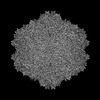
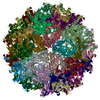


 adeno-associated virus - po1
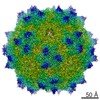 adeno-associated virus