[English] 日本語
Yorodumi Papers
- Database of articles cited by EMDB/PDB/SASBDB data -

+
Search query

Keywords
Structure methods
Author
Journal
IF

-
Structure paper

TitleFunctional and epitope specific monoclonal antibody discovery directly from immune sera using cryo-EM.
Journal, issue, pagesSci Adv, Vol. 11, Issue 33, Page eadv8257, Year 2025
Publish dateAug 15, 2025
AuthorsJames A Ferguson / Sai Sundar Rajan Raghavan / Garazi Peña Alzua / Disha Bhavsar / Jiachen Huang / Alesandra J Rodriguez / Jonathan L Torres / Maria Bottermann / Julianna Han / Florian Krammer / Facundo D Batista / Andrew B Ward /
PubMed AbstractAntibodies are crucial therapeutics, comprising a substantial portion of approved drugs due to their safety and clinical efficacy. Traditional antibody discovery methods are labor-intensive, limiting ...Antibodies are crucial therapeutics, comprising a substantial portion of approved drugs due to their safety and clinical efficacy. Traditional antibody discovery methods are labor-intensive, limiting scalability and high-throughput analysis. Here, we improved upon our streamlined approach combining structural analysis and bioinformatics to infer heavy and light chain sequences from cryo-EM (cryo-electron microscopy) maps of serum-derived polyclonal antibodies (pAbs) bound to antigens. Using ModelAngelo, an automated structure-building tool, we accelerated pAb sequence determination and identified sequence matches in B cell repertoires via ModelAngelo-derived hidden Markov models (HMMs) associated with pAb structures. Benchmarking against results from a nonhuman primate HIV vaccine trial, our pipeline reduced analysis time from weeks to under a day with higher precision. Validation with murine immune sera from influenza vaccination revealed multiple protective antibodies. This workflow enhances antibody discovery, enabling faster, more accurate mapping of polyclonal responses with broad applications in vaccine development and therapeutic antibody discovery.
External linksSci Adv / PubMed:40815640 / PubMed Central
MethodsEM (single particle)
Resolution2.7 - 3.4 Å
Structure data

EMDB-48118: Map of Neuraminidase active site specific polycloncal antibody from sera of 10 mice vaccinated with Indiana 2011 Group 2 Neuraminidase
Method: EM (single particle) / Resolution: 3.3 Å

EMDB-48165, PDB-9md2:
Neuraminidase in complex with mAb 5-6
Method: EM (single particle) / Resolution: 3.4 Å

EMDB-48166, PDB-9md3:
Neuraminidase in complex with mAb 5-12
Method: EM (single particle) / Resolution: 2.9 Å

EMDB-48167, PDB-9md4:
Neuraminidase complexed with mAb 5-16
Method: EM (single particle) / Resolution: 2.7 Å

EMDB-48168, PDB-9md5:
Neuraminidase in complex with mAb 6-23.2
Method: EM (single particle) / Resolution: 2.9 Å

EMDB-48169, PDB-9md6:
Neuraminidase in complex with mAb 6-23.1
Method: EM (single particle) / Resolution: 2.7 Å

Chemicals

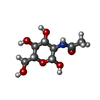
ChemComp-NAG:
2-acetamido-2-deoxy-beta-D-glucopyranose

ChemComp-CA:
Unknown entry

Source
  • Influenza A virus (A/Indiana/10/2011(H3N2))
  • influenza a virus
  • mus musculus (house mouse)
KeywordsVIRAL PROTEIN/IMMUNE SYSTEM / Polyclonal antibodies / Neuraminidase. Influenza / Cryo-EM / IMMUNE SYSTEM / VIRAL PROTEIN-IMMUNE SYSTEM complex / Neuraminidase / Influenza / Polyclonal antibody

+
About Yorodumi Papers

-
News

-
Feb 9, 2022. New format data for meta-information of EMDB entries

New format data for meta-information of EMDB entries

  • Version 3 of the EMDB header file is now the official format.
  • The previous official version 1.9 will be removed from the archive.

Related info.:EMDB header

External links:wwPDB to switch to version 3 of the EMDB data model

-
Aug 12, 2020. Covid-19 info

Covid-19 info

URL: https://pdbj.org/emnavi/covid19.php

New page: Covid-19 featured information page in EM Navigator.

Related info.:Covid-19 info / Mar 5, 2020. Novel coronavirus structure data

+
Mar 5, 2020. Novel coronavirus structure data

Novel coronavirus structure data

Related info.:Yorodumi Speices / Aug 12, 2020. Covid-19 info

External links:COVID-19 featured content - PDBj / Molecule of the Month (242):Coronavirus Proteases

+
Jan 31, 2019. EMDB accession codes are about to change! (news from PDBe EMDB page)

EMDB accession codes are about to change! (news from PDBe EMDB page)

  • The allocation of 4 digits for EMDB accession codes will soon come to an end. Whilst these codes will remain in use, new EMDB accession codes will include an additional digit and will expand incrementally as the available range of codes is exhausted. The current 4-digit format prefixed with “EMD-” (i.e. EMD-XXXX) will advance to a 5-digit format (i.e. EMD-XXXXX), and so on. It is currently estimated that the 4-digit codes will be depleted around Spring 2019, at which point the 5-digit format will come into force.
  • The EM Navigator/Yorodumi systems omit the EMD- prefix.

Related info.:Q: What is EMD? / ID/Accession-code notation in Yorodumi/EM Navigator

External links:EMDB Accession Codes are Changing Soon! / Contact to PDBj

+
Jul 12, 2017. Major update of PDB

Major update of PDB

  • wwPDB released updated PDB data conforming to the new PDBx/mmCIF dictionary.
  • This is a major update changing the version number from 4 to 5, and with Remediation, in which all the entries are updated.
  • In this update, many items about electron microscopy experimental information are reorganized (e.g. em_software).
  • Now, EM Navigator and Yorodumi are based on the updated data.

External links:wwPDB Remediation / Enriched Model Files Conforming to OneDep Data Standards Now Available in the PDB FTP Archive

-
Yorodumi Papers

Database of articles cited by EMDB/PDB/SASBDB data

  • Database of articles cited by EMDB, PDB, and SASBDB entries
  • Using PubMed data

Related info.:EMDB / PDB / SASBDB / Yorodumi / EMN Papers / Changes in new EM Navigator and Yorodumi

Read more