 Movie
Movie Controller
 Structure viewers
 About Yorodumi Papers


+Search query
-Structure paper
| Title | The hemagglutinin-like proteins of basal vertebrate influenza-like viruses exhibit sialic-acid receptor binding disparity and their structural bases. |
|---|---|
| Journal, issue, pages | PLoS Pathog, Vol. 21, Issue 11, Page e1013640, Year 2025 |
| Publish date | Nov 26, 2025 |
 Authors Authors | Di Zhang / Kefang Liu / Yufeng Xie / Junqing Sun / Wei Zhang / Haixia Xiao / Yi Shi / William J Liu / George F Gao / Chuxia Deng / Feng Gao /  |
| PubMed Abstract | In 2018, two novel influenza-like virus genomes were first identified in basal vertebrates: the Asiatic toads (Bufo gargarizans) and spiny eels (Mastacembelus aculeatus). Their hemagglutinin (HA) ...In 2018, two novel influenza-like virus genomes were first identified in basal vertebrates: the Asiatic toads (Bufo gargarizans) and spiny eels (Mastacembelus aculeatus). Their hemagglutinin (HA) proteins exhibit remarkably low amino acid sequences homology (23.0% and 42.8%, respectively) compared to influenza B virus (IBV), their closest canonical influenza virus relative. This study revealed that the Asiatic toad influenza-like virus HA (tHA) demonstrates dual receptor specificity, bound both α2-3 (avian-type) and α2-6 (human-type) sialic acid (SA) receptors, whereas the spiny eel influenza-like virus HA (eHA) lacks this capability. Biophysical characterization showed reduced thermal stability (lower Tm values) for both tHA and eHA compared to canonical influenza HA. Furthermore, we determined the cryo-EM structures of apo-tHA, tHA in complex with either α2-3 SA receptor or α2-6 SA receptor, as well as apo-eHA and eHA bound to GM2 complex. Our analysis revealed that tHA has a shorter length and looser HA trimer packing compared to canonical HA. These findings collectively indicate that influenza-like viruses in basal vertebrates have evolutionarily acquired dual SA receptor-binding capacity, a trait critical for cross-species transmission in influenza viruses. However, the observed thermolability of these HA proteins suggests that host physiological temperatures may impose a barrier to zoonotic spillover. |
 External links External links | PLoS Pathog / PubMed:41296766 / PubMed Central |
| Methods | EM (single particle) |
| Resolution | 2.37 - 2.95 Å |
| Structure data | EMDB-37532, PDB-8wh7: EMDB-37567, PDB-8wis: EMDB-62290, PDB-9ked:  EMDB-65498: Cryo-EM structure of spiny eel influenza-like virus HA and GM2 complex EMDB-65618, PDB-9w44: |
| Chemicals | 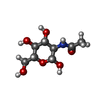 ChemComp-NAG: |
| Source |
|
 Keywords Keywords | VIRAL PROTEIN / Hemagglutinin / Complex |



 wuhan asiatic toad influenza virus