[English] 日本語
Yorodumi Papers
- Database of articles cited by EMDB/PDB/SASBDB data -

+
Search query

Keywords
Structure methods
Author
Journal
IF

-
Structure paper

TitleStructural insights into Wnt/β-catenin signaling regulation by LGR4, R-spondin, and ZNRF3.
Journal, issue, pagesNat Commun, Vol. 16, Issue 1, Page 8337, Year 2025
Publish dateOct 1, 2025
AuthorsYuxuan Peng / Akiko Fujimura / Jinta Asami / Zhikuan Zhang / Toshiyuki Shimizu / Umeharu Ohto /
PubMed AbstractLeucine-rich repeat-containing G protein-coupled receptor 4 (LGR4) plays a critical role in regulating the wingless-related integration site (Wnt) signaling pathway and is essential for organ ...Leucine-rich repeat-containing G protein-coupled receptor 4 (LGR4) plays a critical role in regulating the wingless-related integration site (Wnt) signaling pathway and is essential for organ development and carcinogenesis. LGR4, along with its ligand R-spondin (RSPO), potentiates Wnt/β-catenin signaling by recruiting its signaling suppressor, E3 ligase Zinc and Ring Finger 3 (ZNRF3), and inducing its membrane clearance. However, detailed mechanisms underlying this process remain unknown. In this study, we present the cryo-electron microscopy structures of human LGR4, the LGR4-RSPO2 and LGR4-RSPO2-ZNRF3 complexes. Upon RSPO2 binding, LGR4 undergoes no significant conformational changes in its transmembrane and extracellular domain structures or their relative orientations. LGR4, RSPO2, and ZNRF3 assemble into a 2:2:2 complex with the ZNRF3 dimer enclosed at the center. This ternary arrangement and forced dimerization of ZNRF3 likely underpin how LGR4 and RSPO2 potentiate Wnt/β-catenin signaling by sequestering ZNRF3 from Wnt receptors and facilitating its auto-inactivation. This study provides a structural basis for understanding the regulatory mechanism of Wnt/β-catenin signaling through the LGR4-RSPO2-ZNRF3 pathway and may offer opportunities for future drug development targeting this axis.
External linksNat Commun / PubMed:41034211 / PubMed Central
MethodsEM (single particle)
Resolution3.25 - 3.97 Å
Structure data

EMDB-62218, PDB-9kb6:
Cryo-EM structure of LGR4
Method: EM (single particle) / Resolution: 3.53 Å

EMDB-62219, PDB-9kb7:
Cryo-EM structure of LGR4-RSPO2 complex
Method: EM (single particle) / Resolution: 3.97 Å

EMDB-62220, PDB-9kb8:
Cryo-EM structure of LGR4-RSPO2-ZNRF3 complex (1:1:2)
Method: EM (single particle) / Resolution: 3.25 Å

EMDB-62221, PDB-9kb9:
Cryo-EM structure of LGR4-RSPO2-ZNRF3 complex (2:2:2)
Method: EM (single particle) / Resolution: 3.59 Å

Chemicals

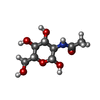
ChemComp-NAG:
2-acetamido-2-deoxy-beta-D-glucopyranose

Source
  • homo sapiens (human)
KeywordsMEMBRANE PROTEIN / Wnt signal

+
About Yorodumi Papers

-
News

-
Feb 9, 2022. New format data for meta-information of EMDB entries

New format data for meta-information of EMDB entries

  • Version 3 of the EMDB header file is now the official format.
  • The previous official version 1.9 will be removed from the archive.

Related info.:EMDB header

External links:wwPDB to switch to version 3 of the EMDB data model

-
Aug 12, 2020. Covid-19 info

Covid-19 info

URL: https://pdbj.org/emnavi/covid19.php

New page: Covid-19 featured information page in EM Navigator.

Related info.:Covid-19 info / Mar 5, 2020. Novel coronavirus structure data

+
Mar 5, 2020. Novel coronavirus structure data

Novel coronavirus structure data

Related info.:Yorodumi Speices / Aug 12, 2020. Covid-19 info

External links:COVID-19 featured content - PDBj / Molecule of the Month (242):Coronavirus Proteases

+
Jan 31, 2019. EMDB accession codes are about to change! (news from PDBe EMDB page)

EMDB accession codes are about to change! (news from PDBe EMDB page)

  • The allocation of 4 digits for EMDB accession codes will soon come to an end. Whilst these codes will remain in use, new EMDB accession codes will include an additional digit and will expand incrementally as the available range of codes is exhausted. The current 4-digit format prefixed with “EMD-” (i.e. EMD-XXXX) will advance to a 5-digit format (i.e. EMD-XXXXX), and so on. It is currently estimated that the 4-digit codes will be depleted around Spring 2019, at which point the 5-digit format will come into force.
  • The EM Navigator/Yorodumi systems omit the EMD- prefix.

Related info.:Q: What is EMD? / ID/Accession-code notation in Yorodumi/EM Navigator

External links:EMDB Accession Codes are Changing Soon! / Contact to PDBj

+
Jul 12, 2017. Major update of PDB

Major update of PDB

  • wwPDB released updated PDB data conforming to the new PDBx/mmCIF dictionary.
  • This is a major update changing the version number from 4 to 5, and with Remediation, in which all the entries are updated.
  • In this update, many items about electron microscopy experimental information are reorganized (e.g. em_software).
  • Now, EM Navigator and Yorodumi are based on the updated data.

External links:wwPDB Remediation / Enriched Model Files Conforming to OneDep Data Standards Now Available in the PDB FTP Archive

-
Yorodumi Papers

Database of articles cited by EMDB/PDB/SASBDB data

  • Database of articles cited by EMDB, PDB, and SASBDB entries
  • Using PubMed data

Related info.:EMDB / PDB / SASBDB / Yorodumi / EMN Papers / Changes in new EM Navigator and Yorodumi

Read more