[English] 日本語
Yorodumi Papers
- Database of articles cited by EMDB/PDB/SASBDB data -

+
Search query

Keywords
Structure methods
Author
Journal
IF

-
Structure paper

TitleStructural insights into the role of reduced cysteine residues in SOD1 amyloid filament formation.
Journal, issue, pagesProc Natl Acad Sci U S A, Vol. 122, Issue 5, Page e2408582122, Year 2025
Publish dateFeb 4, 2025
AuthorsYeongjin Baek / Hyunmin Kim / Dukwon Lee / Doyeon Kim / Eunbyul Jo / Soung-Hun Roh / Nam-Chul Ha /
PubMed AbstractThe formation of superoxide dismutase 1 (SOD1) filaments has been implicated in amyotrophic lateral sclerosis (ALS). Although the disulfide bond formed between Cys57 and Cys146 in the active state ...The formation of superoxide dismutase 1 (SOD1) filaments has been implicated in amyotrophic lateral sclerosis (ALS). Although the disulfide bond formed between Cys57 and Cys146 in the active state has been well studied, the role of the reduced cysteine residues, Cys6 and Cys111, in SOD1 filament formation remains unclear. In this study, we investigated the role of reduced cysteine residues by determining and comparing cryoelectron microscopy (cryo-EM) structures of wild-type (WT) and C6A/C111A SOD1 filaments under thiol-based reducing and metal-depriving conditions, starting with protein samples possessing enzymatic activity. The C6A/C111A mutant SOD1 formed filaments more rapidly than the WT protein. The mutant structure had a unique paired-protofilament arrangement, with a smaller filament core than that of the single-protofilament structure observed in WT SOD1. Although the single-protofilament form developed more slowly, cross-seeding experiments demonstrated the predominance of single-protofilament morphology over paired protofilaments, regardless of the presence of the Cys6 and Cys111 mutations. These findings highlight the importance of the number of amino acid residues within the filament core in determining the energy requirements for assembly. Our study provides insights into ALS pathogenesis by elucidating the initiation and propagation of filament formation, which potentially leads to deleterious amyloid filaments.
External linksProc Natl Acad Sci U S A / PubMed:39874287 / PubMed Central
MethodsEM (helical sym.)
Resolution3.18 - 3.39 Å
Structure data

EMDB-61321, PDB-9jbo:
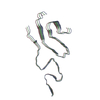
Cryo-EM structure of human SOD1 (WT) amyloid filament
Method: EM (helical sym.) / Resolution: 3.39 Å

EMDB-61322, PDB-9jbp:
Cryo-EM structure of human SOD1 (C6A/C111A) amyloid filament
Method: EM (helical sym.) / Resolution: 3.18 Å

Source
  • homo sapiens (human)
KeywordsPROTEIN FIBRIL / amyloid / filament / superoxide dismutase 1 / amyotrophic lateral sclerosis

+
About Yorodumi Papers

-
News

-
Feb 9, 2022. New format data for meta-information of EMDB entries

New format data for meta-information of EMDB entries

  • Version 3 of the EMDB header file is now the official format.
  • The previous official version 1.9 will be removed from the archive.

Related info.:EMDB header

External links:wwPDB to switch to version 3 of the EMDB data model

-
Aug 12, 2020. Covid-19 info

Covid-19 info

URL: https://pdbj.org/emnavi/covid19.php

New page: Covid-19 featured information page in EM Navigator.

Related info.:Covid-19 info / Mar 5, 2020. Novel coronavirus structure data

+
Mar 5, 2020. Novel coronavirus structure data

Novel coronavirus structure data

Related info.:Yorodumi Speices / Aug 12, 2020. Covid-19 info

External links:COVID-19 featured content - PDBj / Molecule of the Month (242):Coronavirus Proteases

+
Jan 31, 2019. EMDB accession codes are about to change! (news from PDBe EMDB page)

EMDB accession codes are about to change! (news from PDBe EMDB page)

  • The allocation of 4 digits for EMDB accession codes will soon come to an end. Whilst these codes will remain in use, new EMDB accession codes will include an additional digit and will expand incrementally as the available range of codes is exhausted. The current 4-digit format prefixed with “EMD-” (i.e. EMD-XXXX) will advance to a 5-digit format (i.e. EMD-XXXXX), and so on. It is currently estimated that the 4-digit codes will be depleted around Spring 2019, at which point the 5-digit format will come into force.
  • The EM Navigator/Yorodumi systems omit the EMD- prefix.

Related info.:Q: What is EMD? / ID/Accession-code notation in Yorodumi/EM Navigator

External links:EMDB Accession Codes are Changing Soon! / Contact to PDBj

+
Jul 12, 2017. Major update of PDB

Major update of PDB

  • wwPDB released updated PDB data conforming to the new PDBx/mmCIF dictionary.
  • This is a major update changing the version number from 4 to 5, and with Remediation, in which all the entries are updated.
  • In this update, many items about electron microscopy experimental information are reorganized (e.g. em_software).
  • Now, EM Navigator and Yorodumi are based on the updated data.

External links:wwPDB Remediation / Enriched Model Files Conforming to OneDep Data Standards Now Available in the PDB FTP Archive

-
Yorodumi Papers

Database of articles cited by EMDB/PDB/SASBDB data

  • Database of articles cited by EMDB, PDB, and SASBDB entries
  • Using PubMed data

Related info.:EMDB / PDB / SASBDB / Yorodumi / EMN Papers / Changes in new EM Navigator and Yorodumi

Read more