[English] 日本語
Yorodumi Papers
- Database of articles cited by EMDB/PDB/SASBDB data -

+
Search query

Keywords
Structure methods
Author
Journal
IF

-
Structure paper

TitleNumerous rRNA molecules form the apicomplexan mitoribosome via repurposed protein and RNA elements.
Journal, issue, pagesNat Commun, Vol. 16, Issue 1, Page 817, Year 2025
Publish dateJan 18, 2025
AuthorsShikha Shikha / Victor Tobiasson / Mariana Ferreira Silva / Jana Ovciarikova / Dario Beraldi / Alexander Mühleip / Lilach Sheiner /
PubMed AbstractMitochondrial ribosomes (mitoribosomes) are essential, and their function of synthesising mitochondrial proteins is universal. The core of almost all mitoribosomes is formed from a small number of ...Mitochondrial ribosomes (mitoribosomes) are essential, and their function of synthesising mitochondrial proteins is universal. The core of almost all mitoribosomes is formed from a small number of long and self-folding rRNA molecules. In contrast, the mitoribosome of the apicomplexan parasite Toxoplasma gondii assembles from over 50 extremely short rRNA molecules. Here, we use cryo-EM to discover the features that enable this unusual mitoribosome to perform its function. We reveal that poly-A tails added to rRNA molecules are integrated into the ribosome, and we demonstrate their essentiality for mitoribosome formation and for parasite survival. This is a distinct function for poly-A tails, which are otherwise known primarily as stabilisers of messenger RNAs. Furthermore, while ribosomes typically consist of unique rRNA sequences, here nine sequences are used twice, each copy integrated in a different mitoribosome domain, revealing one of the mechanisms enabling the extreme mitochondrial genome reduction characteristic to Apicomplexa and to a large group of related microbial eukaryotes. Finally, several transcription factor-like proteins are repurposed to compensate for reduced or lost critical ribosomal domains, including members of the ApiAP2 family thus far considered to be DNA-binding transcription factors.
External linksNat Commun / PubMed:39827269 / PubMed Central
MethodsEM (single particle)
Resolution2.2 - 2.52 Å
Structure data

EMDB-52348, PDB-9hqv:
Cryo-EM structure of the small subunit of the mitochondrial ribosome from Toxoplasma gondii
Method: EM (single particle) / Resolution: 2.52 Å

EMDB-52551, PDB-9i05:
Cryo-EM structure of the large subunit of the mitochondrial ribosome from Toxoplasma gondii
Method: EM (single particle) / Resolution: 2.2 Å

Chemicals

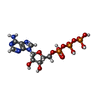
ChemComp-ATP:
ADENOSINE-5'-TRIPHOSPHATE / ATP, energy-carrying molecule*YM

ChemComp-MG:
Unknown entry

ChemComp-ZN:
Unknown entry

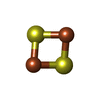
ChemComp-FES:
FE2/S2 (INORGANIC) CLUSTER

Source
  • toxoplasma gondii (eukaryote)
KeywordsRIBOSOME / Toxoplasma gondii / parasite / mitochondrial ribosome / SSU / large subunit / LSU

+
About Yorodumi Papers

-
News

-
Feb 9, 2022. New format data for meta-information of EMDB entries

New format data for meta-information of EMDB entries

  • Version 3 of the EMDB header file is now the official format.
  • The previous official version 1.9 will be removed from the archive.

Related info.:EMDB header

External links:wwPDB to switch to version 3 of the EMDB data model

-
Aug 12, 2020. Covid-19 info

Covid-19 info

URL: https://pdbj.org/emnavi/covid19.php

New page: Covid-19 featured information page in EM Navigator.

Related info.:Covid-19 info / Mar 5, 2020. Novel coronavirus structure data

+
Mar 5, 2020. Novel coronavirus structure data

Novel coronavirus structure data

Related info.:Yorodumi Speices / Aug 12, 2020. Covid-19 info

External links:COVID-19 featured content - PDBj / Molecule of the Month (242):Coronavirus Proteases

+
Jan 31, 2019. EMDB accession codes are about to change! (news from PDBe EMDB page)

EMDB accession codes are about to change! (news from PDBe EMDB page)

  • The allocation of 4 digits for EMDB accession codes will soon come to an end. Whilst these codes will remain in use, new EMDB accession codes will include an additional digit and will expand incrementally as the available range of codes is exhausted. The current 4-digit format prefixed with “EMD-” (i.e. EMD-XXXX) will advance to a 5-digit format (i.e. EMD-XXXXX), and so on. It is currently estimated that the 4-digit codes will be depleted around Spring 2019, at which point the 5-digit format will come into force.
  • The EM Navigator/Yorodumi systems omit the EMD- prefix.

Related info.:Q: What is EMD? / ID/Accession-code notation in Yorodumi/EM Navigator

External links:EMDB Accession Codes are Changing Soon! / Contact to PDBj

+
Jul 12, 2017. Major update of PDB

Major update of PDB

  • wwPDB released updated PDB data conforming to the new PDBx/mmCIF dictionary.
  • This is a major update changing the version number from 4 to 5, and with Remediation, in which all the entries are updated.
  • In this update, many items about electron microscopy experimental information are reorganized (e.g. em_software).
  • Now, EM Navigator and Yorodumi are based on the updated data.

External links:wwPDB Remediation / Enriched Model Files Conforming to OneDep Data Standards Now Available in the PDB FTP Archive

-
Yorodumi Papers

Database of articles cited by EMDB/PDB/SASBDB data

  • Database of articles cited by EMDB, PDB, and SASBDB entries
  • Using PubMed data

Related info.:EMDB / PDB / SASBDB / Yorodumi / EMN Papers / Changes in new EM Navigator and Yorodumi

Read more