[English] 日本語
Yorodumi Papers
- Database of articles cited by EMDB/PDB/SASBDB data -

+
Search query

Keywords
Structure methods
Author
Journal
IF

-
Structure paper

TitleMavacamten inhibits myosin activity by stabilising the myosin interacting-heads motif and stalling motor force generation.
Journal, issue, pagesbioRxiv, Year 2025
Publish dateFeb 17, 2025
AuthorsSean N McMillan / Jaime R T Pitts / Bipasha Barua / Donald A Winkelmann / Charlotte A Scarff /
PubMed AbstractMost sudden cardiac deaths in young people arise from hypertrophic cardiomyopathy, a genetic disease of the heart muscle, with many causative mutations found in the molecular motor beta-cardiac ...Most sudden cardiac deaths in young people arise from hypertrophic cardiomyopathy, a genetic disease of the heart muscle, with many causative mutations found in the molecular motor beta-cardiac myosin that drives contraction. Therapeutic intervention has until recently been limited to symptomatic relief or invasive procedures. However, small molecule modulators of cardiac myosin are promising therapeutic options to target disease progression. Mavacamten is the first example to gain FDA approval but its molecular mode of action remains unclear, limiting our understanding of its functional effects in disease. To better understand this, we solved the cryoEM structures of beta-cardiac heavy meromyosin in three ADP.Pi-bound states, the primed motor domain in the presence and absence of mavacamten, and the sequestered autoinhibited interacting-heads motif (IHM) in complex with mavacamten, to 2.9 Å, 3.4 Å and 3.7 Å global resolution respectively. Together with quantitative crosslinking mass spectrometric analysis, these structures reveal how mavacamten inhibits myosin. Mavacamten stabilises ADP.Pi binding, stalling the motor domain in a primed state, reducing motor dynamics required for actin-binding cleft closure, and slowing progression through the force generation cycle. Within the two-headed myosin molecule, these effects are propagated and lead to stabilisation of the IHM, through increased contacts at the motor-motor interface. Critically, while mavacamten treatment can thus rescue cardiac muscle relaxation in diastole, it can also reduce contractile output in systole in the heart.
External linksbioRxiv / PubMed:39990378 / PubMed Central
MethodsEM (single particle)
Resolution2.9 - 3.7 Å
Structure data

EMDB-51719, PDB-9gz1:
Beta-cardiac myosin interacting heads motif complexed to mavacamten
Method: EM (single particle) / Resolution: 3.7 Å

EMDB-51720, PDB-9gz2:
Beta-cardiac heavy meromyosin motor domain in the primed state complexed to mavacamten
Method: EM (single particle) / Resolution: 2.9 Å

EMDB-51721, PDB-9gz3:
Beta-cardiac heavy meromyosin motor domain in the primed state
Method: EM (single particle) / Resolution: 3.4 Å

Chemicals

ChemComp-MG:
Unknown entry

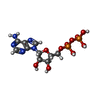
ChemComp-ADP:
ADENOSINE-5'-DIPHOSPHATE / ADP, energy-carrying molecule*YM

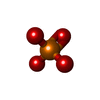
ChemComp-PO4:
PHOSPHATE ION

ChemComp-XB2:
6-[[(1~{S})-1-phenylethyl]amino]-3-propan-2-yl-1~{H}-pyrimidine-2,4-dione / medication, inhibitor*YM

Source
  • homo sapiens (human)
  • mus musculus (house mouse)
KeywordsMOTOR PROTEIN / Mavacamten / Inhibitor / Interacting heads motif / myosin / Primed myosin

+
About Yorodumi Papers

-
News

-
Feb 9, 2022. New format data for meta-information of EMDB entries

New format data for meta-information of EMDB entries

  • Version 3 of the EMDB header file is now the official format.
  • The previous official version 1.9 will be removed from the archive.

Related info.:EMDB header

External links:wwPDB to switch to version 3 of the EMDB data model

-
Aug 12, 2020. Covid-19 info

Covid-19 info

URL: https://pdbj.org/emnavi/covid19.php

New page: Covid-19 featured information page in EM Navigator.

Related info.:Covid-19 info / Mar 5, 2020. Novel coronavirus structure data

+
Mar 5, 2020. Novel coronavirus structure data

Novel coronavirus structure data

Related info.:Yorodumi Speices / Aug 12, 2020. Covid-19 info

External links:COVID-19 featured content - PDBj / Molecule of the Month (242):Coronavirus Proteases

+
Jan 31, 2019. EMDB accession codes are about to change! (news from PDBe EMDB page)

EMDB accession codes are about to change! (news from PDBe EMDB page)

  • The allocation of 4 digits for EMDB accession codes will soon come to an end. Whilst these codes will remain in use, new EMDB accession codes will include an additional digit and will expand incrementally as the available range of codes is exhausted. The current 4-digit format prefixed with “EMD-” (i.e. EMD-XXXX) will advance to a 5-digit format (i.e. EMD-XXXXX), and so on. It is currently estimated that the 4-digit codes will be depleted around Spring 2019, at which point the 5-digit format will come into force.
  • The EM Navigator/Yorodumi systems omit the EMD- prefix.

Related info.:Q: What is EMD? / ID/Accession-code notation in Yorodumi/EM Navigator

External links:EMDB Accession Codes are Changing Soon! / Contact to PDBj

+
Jul 12, 2017. Major update of PDB

Major update of PDB

  • wwPDB released updated PDB data conforming to the new PDBx/mmCIF dictionary.
  • This is a major update changing the version number from 4 to 5, and with Remediation, in which all the entries are updated.
  • In this update, many items about electron microscopy experimental information are reorganized (e.g. em_software).
  • Now, EM Navigator and Yorodumi are based on the updated data.

External links:wwPDB Remediation / Enriched Model Files Conforming to OneDep Data Standards Now Available in the PDB FTP Archive

-
Yorodumi Papers

Database of articles cited by EMDB/PDB/SASBDB data

  • Database of articles cited by EMDB, PDB, and SASBDB entries
  • Using PubMed data

Related info.:EMDB / PDB / SASBDB / Yorodumi / EMN Papers / Changes in new EM Navigator and Yorodumi

Read more