 ムービー
ムービー コントローラー
 構造ビューア
 万見文献について


+検索条件
-Structure paper
| タイトル | Filament formation activates protease and ring nuclease activities of CRISPR Lon-SAVED. |
|---|---|
| ジャーナル・号・ページ | Mol Cell, Vol. 84, Issue 21, Page 4239-44255.e8, Year 2024 |
| 掲載日 | 2024年11月7日 |
 著者 著者 | Dalia Smalakyte / Audrone Ruksenaite / Giedrius Sasnauskas / Giedre Tamulaitiene / Gintautas Tamulaitis |
| PubMed 要旨 | To combat phage infection, type III CRISPR-Cas systems utilize cyclic oligoadenylates (cA) signaling to activate various auxiliary effectors, including the CRISPR-associated Lon-SAVED protease CalpL, ...To combat phage infection, type III CRISPR-Cas systems utilize cyclic oligoadenylates (cA) signaling to activate various auxiliary effectors, including the CRISPR-associated Lon-SAVED protease CalpL, which forms a tripartite effector system together with an anti-σ factor, CalpT, and an ECF-like σ factor, CalpS. Here, we report the characterization of the Candidatus Cloacimonas acidaminovorans CalpL-CalpT-CalpS. We demonstrate that cA binding triggers CalpL filament formation and activates it to cleave CalpT within the CalpT-CalpS dimer. This cleavage exposes the CalpT C-degron, which targets it for further degradation by cellular proteases. Consequently, CalpS is released to bind to RNA polymerase, causing growth arrest in E. coli. Furthermore, the CalpL-CalpT-CalpS system is regulated by the SAVED domain of CalpL, which is a ring nuclease that cleaves cA in a sequential three-step mechanism. These findings provide key mechanistic details for the activation, proteolytic events, and regulation of the signaling cascade in the type III CRISPR-Cas immunity. |
 リンク リンク | Mol Cell / PubMed:39362215 |
| 手法 | EM (単粒子) |
| 解像度 | 2.75 - 2.97 Å |
| 構造データ | EMDB-50054, PDB-9eyi: EMDB-50055, PDB-9eyj: EMDB-50056, PDB-9eyk: |
| 由来 |
|
 キーワード キーワード | HYDROLASE / LON PROTEASE / SAVED DOMAIN / CRISPR |


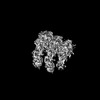

 candidatus cloacimonas acidaminovorans (バクテリア)