[English] 日本語
Yorodumi Papers
- Database of articles cited by EMDB/PDB/SASBDB data -

+
Search query

Keywords
Structure methods
Author
Journal
IF

-
Structure paper

TitleProlonged signaling of backbone-modified glucagon-like peptide- analogues with diverse receptor trafficking.
Journal, issue, pagesProc Natl Acad Sci U S A, Vol. 122, Issue 14, Page e2407574122, Year 2025
Publish dateApr 8, 2025
AuthorsBrian P Cary / Marlies V Hager / Zamara Mariam / Rylie K Morris / Matthew J Belousoff / Giuseppe Deganutti / Patrick M Sexton / Denise Wootten / Samuel H Gellman /
PubMed AbstractSignal duration and subcellular location are emerging as important facets of G protein-coupled receptor (GPCR) function. The glucagon-like peptide-1 receptor (GLP-1R), a clinically relevant class B1 ...Signal duration and subcellular location are emerging as important facets of G protein-coupled receptor (GPCR) function. The glucagon-like peptide-1 receptor (GLP-1R), a clinically relevant class B1 GPCR, stimulates production of the second messenger cyclic adenosine monophosphate (cAMP) upon activation by the native hormone, GLP-1. cAMP production continues after the hormone-receptor complex has been internalized via endocytosis. Here, we report GLP-1 analogues that induce prolonged signaling relative to GLP-1. A single β-amino acid substitution at position 18, with the residue derived from (,)--2-aminocyclopentanecarboxylic acid (ACPC), enhances signaling duration with retention of receptor endocytosis. Pairing ACPC at position 18 with a second substitution, α-aminoisobutyric acid (Aib) at position 16, abrogates endocytosis, but prolonged signaling is maintained. Prolonged signaling is sensitive to the structure of the β residue at position 18. Cryoelectron microscopy structures of two GLP-1 analogues bound to the GLP-1R:Gs complex suggest substantial alterations to bound peptide structure and dynamics compared to the GLP-1:GLP-1R:Gs complex. These structural findings strengthen an emerging view that agonist dynamics in the receptor-bound state influence signaling profiles. Our results advance understanding of the structural underpinnings of receptor activation and introduce tools for exploring the impact of spatiotemporal signaling profiles following GLP-1R activation.
External linksProc Natl Acad Sci U S A / PubMed:40168114 / PubMed Central
MethodsEM (single particle)
Resolution3.13 - 3.44 Å
Structure data

EMDB-47882, PDB-9ebn:
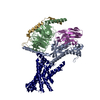
Peptide 1 (GLP-1 (Aib16, ACPC18)) bound to GLP-1R/Gs complex
Method: EM (single particle) / Resolution: 3.44 Å

EMDB-47883, PDB-9ebo:
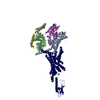
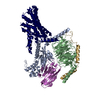
Peptide 2 (GLP-1 (ACPC18)) bound to GLP-1R/Gs complex (conformer 1)
Method: EM (single particle) / Resolution: 3.13 Å

EMDB-47884, PDB-9ebq:
Peptide 2 (GLP-1 (ACPC18)) bound to GLP-1R/Gs complex (conformer 2)
Method: EM (single particle) / Resolution: 3.16 Å

Source
  • homo sapiens (human)
  • lama glama (llama)
  • synthetic construct (others)
KeywordsMEMBRANE PROTEIN / G protein / agonist / backbone / GLP-1 / glucagon

+
About Yorodumi Papers

-
News

-
Feb 9, 2022. New format data for meta-information of EMDB entries

New format data for meta-information of EMDB entries

  • Version 3 of the EMDB header file is now the official format.
  • The previous official version 1.9 will be removed from the archive.

Related info.:EMDB header

External links:wwPDB to switch to version 3 of the EMDB data model

-
Aug 12, 2020. Covid-19 info

Covid-19 info

URL: https://pdbj.org/emnavi/covid19.php

New page: Covid-19 featured information page in EM Navigator.

Related info.:Covid-19 info / Mar 5, 2020. Novel coronavirus structure data

+
Mar 5, 2020. Novel coronavirus structure data

Novel coronavirus structure data

Related info.:Yorodumi Speices / Aug 12, 2020. Covid-19 info

External links:COVID-19 featured content - PDBj / Molecule of the Month (242):Coronavirus Proteases

+
Jan 31, 2019. EMDB accession codes are about to change! (news from PDBe EMDB page)

EMDB accession codes are about to change! (news from PDBe EMDB page)

  • The allocation of 4 digits for EMDB accession codes will soon come to an end. Whilst these codes will remain in use, new EMDB accession codes will include an additional digit and will expand incrementally as the available range of codes is exhausted. The current 4-digit format prefixed with “EMD-” (i.e. EMD-XXXX) will advance to a 5-digit format (i.e. EMD-XXXXX), and so on. It is currently estimated that the 4-digit codes will be depleted around Spring 2019, at which point the 5-digit format will come into force.
  • The EM Navigator/Yorodumi systems omit the EMD- prefix.

Related info.:Q: What is EMD? / ID/Accession-code notation in Yorodumi/EM Navigator

External links:EMDB Accession Codes are Changing Soon! / Contact to PDBj

+
Jul 12, 2017. Major update of PDB

Major update of PDB

  • wwPDB released updated PDB data conforming to the new PDBx/mmCIF dictionary.
  • This is a major update changing the version number from 4 to 5, and with Remediation, in which all the entries are updated.
  • In this update, many items about electron microscopy experimental information are reorganized (e.g. em_software).
  • Now, EM Navigator and Yorodumi are based on the updated data.

External links:wwPDB Remediation / Enriched Model Files Conforming to OneDep Data Standards Now Available in the PDB FTP Archive

-
Yorodumi Papers

Database of articles cited by EMDB/PDB/SASBDB data

  • Database of articles cited by EMDB, PDB, and SASBDB entries
  • Using PubMed data

Related info.:EMDB / PDB / SASBDB / Yorodumi / EMN Papers / Changes in new EM Navigator and Yorodumi

Read more