 Movie
Movie Controller
 Structure viewers
 About Yorodumi Papers


+Search query
-Structure paper
| Title | Small-molecule modulation of β-arrestins. |
|---|---|
| Journal, issue, pages | Nature, Vol. 656, Issue 8128, Page 770-779, Year 2026 |
| Publish date | Jun 24, 2026 |
 Authors Authors | Alem W Kahsai / Natalia Pakharukova / Henry Y Kwon / Kunal S Shah / Caroline T Del Real / Bowie N Shreiber / Jason G Liang-Lin / Paul J Shim / Mason A Lee / Van A Ngo / Allison M Schwalb / Uyen Pham / Anand Chundi / Haoran Jiang / Emmanuel Flores-Espinoza / Samuel Liu / Preston C Nibley / Dana K Bassford / Hyunggu Hahn / Cal A Kunzle / Brittany N Thomas / Jihee Kim / Yang Zhou / Jialu Wang / Xingdong Zhang / Jeffrey S Smith / Lindsay A M Rein / Alex R B Thomsen / Sudha K Shenoy / Sudarshan Rajagopal / Lei Shi / Seungkirl Ahn / Howard A Rockman / Ali Masoudi / Robert J Lefkowitz /  |
| PubMed Abstract | β-Arrestins are multifunctional regulators of G-protein-coupled receptor (GPCR) signalling and orchestrate diverse downstream signalling events and physiological responses across the GPCR ...β-Arrestins are multifunctional regulators of G-protein-coupled receptor (GPCR) signalling and orchestrate diverse downstream signalling events and physiological responses across the GPCR superfamily. Although GPCR pharmacology has advanced to target orthosteric and allosteric sites, as well as G proteins and GPCR kinases, direct chemical tools to modulate β-arrestin activities have remained conspicuously absent. Here we report the identification of small-molecule inhibitors that selectively target β-arrestins and delineate their mechanism of action through integrated pharmacological, biochemical, biophysical and structural analyses. These inhibitors disrupt β-arrestin engagement with agonist-activated GPCRs, impairing desensitization, internalization and β-arrestin-dependent physiological functions while sparing G protein-receptor coupling. Cryo-electron microscopy, molecular dynamics simulations and structure-guided mutagenesis reveal that one modulator, Cmpd-5, engages a pocket within the central crest of β-arrestin1 formed by the middle, C and lariat loops, a critical receptor-binding interface, stabilizing a distinct conformation that is incompatible with full β-arrestin-receptor engagement. Together, these findings establish a mechanistic framework for β-arrestin modulation, reveal a novel allosteric site for structure-based drug design, and open new avenues for transducer-targeted, pathway-specific GPCR therapeutic agents. |
 External links External links | Nature / PubMed:42343124 / PubMed Central |
| Methods | EM (single particle) |
| Resolution | 3.47 - 3.52 Å |
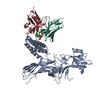
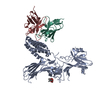
| Structure data | EMDB-47040, PDB-9dng: EMDB-47042, PDB-9dnm: |
| Chemicals | 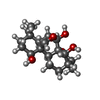 ChemComp-ODN: |
| Source |
|
 Keywords Keywords | SIGNALING PROTEIN/Immune System / GPCR signaling / arrestin / SIGNALING PROTEIN / SIGNALING PROTEIN-Immune System complex / allostery |


 rattus norvegicus (Norway rat)
 homo sapiens (human)