[English] 日本語
Yorodumi Papers
- Database of articles cited by EMDB/PDB/SASBDB data -

+
Search query

Keywords
Structure methods
Author
Journal
IF

-
Structure paper

TitleInhibiting heme piracy by pathogenic Escherichia coli using de novo-designed proteins.
Journal, issue, pagesNat Commun, Vol. 16, Issue 1, Page 6066, Year 2025
Publish dateJul 9, 2025
AuthorsDaniel R Fox / Kazem Asadollahi / Imogen Samuels / Bradley A Spicer / Ashleigh Kropp / Christopher J Lupton / Kevin Lim / Chunxiao Wang / Hari Venugopal / Marija Dramicanin / Gavin J Knott / Rhys Grinter /
PubMed AbstractIron is an essential nutrient for most bacteria and is often growth-limiting during infection, due to the host sequestering free iron as part of the innate immune response. To obtain the iron ...Iron is an essential nutrient for most bacteria and is often growth-limiting during infection, due to the host sequestering free iron as part of the innate immune response. To obtain the iron required for growth, many bacterial pathogens encode transporters capable of extracting the iron-containing cofactor heme directly from host proteins. Pathogenic E. coli and Shigella spp. produce the outer membrane transporter ChuA, which binds host hemoglobin and extracts its heme cofactor, before importing heme into the cell. Heme extraction by ChuA is a dynamic process, with the transporter capable of rapidly extracting heme from hemoglobin in the absence of an external energy source, without forming a stable ChuA-hemoglobin complex. In this work, we utilise a combination of structural modelling, Cryo-EM, X-ray crystallography, mutagenesis, and phenotypic analysis to understand the mechanistic detail of this process. Based on this understanding we utilise artificial intelligence-based protein design to create binders capable of inhibiting E. coli growth by blocking hemoglobin binding to ChuA. By screening a limited number of these designs, we identify several binders that inhibit E. coli growth at low nanomolar concentrations, without experimental optimisation. We determine the structure of a subset of these binders, alone and in complex with ChuA, demonstrating that they closely match the computational design. This work demonstrates the utility of de novo-designed proteins for inhibiting bacterial nutrient uptake and uses a workflow that could be applied to integral membrane proteins in other organisms.
External linksNat Commun / PubMed:40634285 / PubMed Central
MethodsEM (single particle) / X-ray diffraction
Resolution2.46 - 3.2 Å
Structure data

EMDB-46916, PDB-9dir:
Cryo-EM structure of the heme/hemoglobin transporter ChuA, in complex with de novo designed binder G7
Method: EM (single particle) / Resolution: 2.97 Å

EMDB-46917, PDB-9dis:
Cryo-EM structure of the heme/hemoglobin transporter ChuA, in complex with de novo designed binder H3
Method: EM (single particle) / Resolution: 2.51 Å

PDB-9dhe:
The crystal structure on the heme/hemoglobin transporter ChuA, in complex with heme
Method: X-RAY DIFFRACTION / Resolution: 3.2 Å

PDB-9div:
The crystal structure of de novo designed ChuA binding protein C8
Method: X-RAY DIFFRACTION / Resolution: 2.46 Å

Chemicals

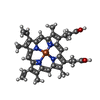
ChemComp-HEM:
PROTOPORPHYRIN IX CONTAINING FE

ChemComp-HOH:
WATER

Source
  • escherichia coli (E. coli)
  • synthetic construct (others)
  • escherichia coli cft073 (bacteria)
KeywordsTRANSPORT PROTEIN / TonB-dependent transporter / ChuA / Heme / Hemoglobin / Outer-membrane / de novo designed protein / binding protein

+
About Yorodumi Papers

-
News

-
Feb 9, 2022. New format data for meta-information of EMDB entries

New format data for meta-information of EMDB entries

  • Version 3 of the EMDB header file is now the official format.
  • The previous official version 1.9 will be removed from the archive.

Related info.:EMDB header

External links:wwPDB to switch to version 3 of the EMDB data model

-
Aug 12, 2020. Covid-19 info

Covid-19 info

URL: https://pdbjlvh1.pdbj.org/emnavi/covid19.php

New page: Covid-19 featured information page in EM Navigator.

Related info.:Covid-19 info / Mar 5, 2020. Novel coronavirus structure data

+
Mar 5, 2020. Novel coronavirus structure data

Novel coronavirus structure data

Related info.:Yorodumi Speices / Aug 12, 2020. Covid-19 info

External links:COVID-19 featured content - PDBj / Molecule of the Month (242):Coronavirus Proteases

+
Jan 31, 2019. EMDB accession codes are about to change! (news from PDBe EMDB page)

EMDB accession codes are about to change! (news from PDBe EMDB page)

  • The allocation of 4 digits for EMDB accession codes will soon come to an end. Whilst these codes will remain in use, new EMDB accession codes will include an additional digit and will expand incrementally as the available range of codes is exhausted. The current 4-digit format prefixed with “EMD-” (i.e. EMD-XXXX) will advance to a 5-digit format (i.e. EMD-XXXXX), and so on. It is currently estimated that the 4-digit codes will be depleted around Spring 2019, at which point the 5-digit format will come into force.
  • The EM Navigator/Yorodumi systems omit the EMD- prefix.

Related info.:Q: What is EMD? / ID/Accession-code notation in Yorodumi/EM Navigator

External links:EMDB Accession Codes are Changing Soon! / Contact to PDBj

+
Jul 12, 2017. Major update of PDB

Major update of PDB

  • wwPDB released updated PDB data conforming to the new PDBx/mmCIF dictionary.
  • This is a major update changing the version number from 4 to 5, and with Remediation, in which all the entries are updated.
  • In this update, many items about electron microscopy experimental information are reorganized (e.g. em_software).
  • Now, EM Navigator and Yorodumi are based on the updated data.

External links:wwPDB Remediation / Enriched Model Files Conforming to OneDep Data Standards Now Available in the PDB FTP Archive

-
Yorodumi Papers

Database of articles cited by EMDB/PDB/SASBDB data

  • Database of articles cited by EMDB, PDB, and SASBDB entries
  • Using PubMed data

Related info.:EMDB / PDB / SASBDB / Yorodumi / EMN Papers / Changes in new EM Navigator and Yorodumi

Read more