 Movie
Movie Controller
 Structure viewers
 About Yorodumi Papers


+Search query
-Structure paper
| Title | The role of ATP-binding Cassette subfamily B member 6 in the inner ear. |
|---|---|
| Journal, issue, pages | Nat Commun, Vol. 15, Issue 1, Page 9885, Year 2024 |
| Publish date | Nov 18, 2024 |
 Authors Authors | Stefanie A Baril / Katie A Wilson / Md Munan Shaik / Yu Fukuda / Robyn A Umans / Alessandro Barbieri / John Lynch / Tomoka Gose / Alexander Myasnikov / Michael L Oldham / Yao Wang / Jingwen Zhu / Jie Fang / Jian Zuo / Ravi C Kalathur / Robert C Ford / Allison Coffin / Michael R Taylor / Megan L O'Mara / John D Schuetz /      |
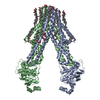
| PubMed Abstract | ABCB6 has been implicated in dyschromatosis universalis hereditaria, a condition characterized by hyperpigmented and hypopigmented skin macules. Dyschromatosis universalis hereditaria can also ...ABCB6 has been implicated in dyschromatosis universalis hereditaria, a condition characterized by hyperpigmented and hypopigmented skin macules. Dyschromatosis universalis hereditaria can also present with hearing loss. Dyschromatosis universalis hereditaria-associated mutations in ABCB6 have been reported, but the role of this protein in the inner ear has not been studied. Here we determine a high-resolution (2.93 Å) cryo-EM structure of ABCB6 and functionally characterized several dyschromatosis universalis hereditaria mutants. We find that the L356P mutant abolishes ABCB6 function, and affirm the underlying loss of ATP binding mechanism using molecular dynamics simulations based on our cryo-EM structure. To test the role of ABCB6 in the inner ear, we characterize Abcb6 (the ABCB6 homolog) in zebrafish. We show that Abcb6 suppression by morpholinos reduces inner ear and lateral line hair cell numbers. Morphants also lack the utricular otolith, which is associated with vestibular function. Co-injecting morpholinos with human ABCB6 mRNA partially rescues the morphant phenotype, suggesting that Abcb6 plays a developmental role in inner ear structures. Further, we show that Abcb6 knockout mice exhibit an increased auditory brainstem response threshold, resulting in reduced hearing sensitivity. Taken together, these data suggest ABCB6 plays a role in inner ear development and function. |
 External links External links | Nat Commun / PubMed:39557842 / PubMed Central |
| Methods | EM (single particle) |
| Resolution | 2.9 Å |
| Structure data | EMDB-46724, PDB-9dbq: |
| Chemicals | 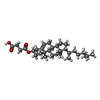 ChemComp-Y01: |
| Source |
|
 Keywords Keywords | MEMBRANE PROTEIN / transporter / ATPase |

 homo sapiens (human)