 Movie
Movie Controller
 Structure viewers
 About Yorodumi Papers


+Search query
-Structure paper
| Title | Structural basis of disease mutation and substrate recognition by the human SLC2A9 transporter. |
|---|---|
| Journal, issue, pages | Proc Natl Acad Sci U S A, Vol. 122, Issue 7, Page e2418282122, Year 2025 |
| Publish date | Feb 18, 2025 |
 Authors Authors | Nitesh Kumar Khandelwal / Meghna Gupta / Paras Kumar / Sree Ganesh Balasubramani / Ignacia Echeverria / Robert M Stroud /  |
| PubMed Abstract | Urate provides ~50% of the reducing potential in human and primate plasma which is key to detoxifying reactive oxygen by-products of cellular metabolism. Urate is the endpoint of purine metabolism in ...Urate provides ~50% of the reducing potential in human and primate plasma which is key to detoxifying reactive oxygen by-products of cellular metabolism. Urate is the endpoint of purine metabolism in primates, and its concentration in plasma is a balance between excretion from kidney and intestine, and subsequent reabsorption in and through cells of kidney proximal tubules to maintain a regulated concentration in plasma. SLC2A9 is the primary transporter that returns urate from the basolateral side of kidney tubule cells back to plasma. A shorter splice variant of SLC2A9 is directed to the apical surface where several transporters recapture urate from the tubule back into cells. Too high a concentration in plasma causes hyperuricemia, is linked to gout, and favors kidney stone formation. To understand the molecular basis of uric acid transport and the role of disease-causing mutations in SLC2A9, we determined structures of human SLC2A9 in its apo form, and its urate-bound form by cryo-EM, at resolution of 3.3 Å and 4.1 Å respectively. Both structures are captured in an inward open conformation. Using the inward-facing structure as a template we modeled the outward-facing conformation to understand the alternating access mechanism. Alternative salt bridge pairs on the cytoplasmic side suggest a mechanism that can balance the energetics of the inward open and outward open states. The location of disease-causing mutants suggests their role in impacting function. Our structures elucidate the molecular basis for urate selectivity and transport and provide a platform for future structure-based drug discovery aimed at reducing plasma urate levels in diseases of hyperuricemia and gout. |
 External links External links | Proc Natl Acad Sci U S A / PubMed:39937868 / PubMed Central |
| Methods | EM (single particle) |
| Resolution | 3.37 - 4.15 Å |
| Structure data | EMDB-45406, PDB-9cax: EMDB-45421, PDB-9cbb: |
| Chemicals |  ChemComp-URC: |
| Source |
|
 Keywords Keywords | MEMBRANE PROTEIN / Transporter |

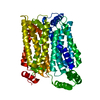


 Homo sapiens (Human) (human)