 Movie
Movie Controller
 Structure viewers
 About Yorodumi Papers


+Search query
-Structure paper
| Title | Occupancy of the HbYX hydrophobic pocket is sufficient to induce gate opening in the archaeal 20S proteasomes. |
|---|---|
| Journal, issue, pages | bioRxiv, Year 2025 |
| Publish date | Feb 25, 2025 |
 Authors Authors | Janelle J Y Chuah / Madalena R Daugherty / David M Smith /  |
| PubMed Abstract | Enhancing proteasome function has been a long-standing but challenging target of interest for the potential treatment of neurodegenerative diseases, emphasizing the importance of understanding ...Enhancing proteasome function has been a long-standing but challenging target of interest for the potential treatment of neurodegenerative diseases, emphasizing the importance of understanding proteasome activation mechanisms. Most proteasome activator complexes use the C-terminal HbYX (hydrophobic-tyrosine-almost any residue) motif to bind and trigger gate-opening in the 20S proteasome. This study defines a critical molecular interaction in the HbYX mechanism that triggers gate opening. We focus on the Hb site interaction and find it plays a surprisingly central and crucial role in driving the allosteric conformational changes that induce gate opening in the archaeal 20S. We examined the cryo-EM structure of two mutant archaeal proteasomes, αV24Y T20S and αV24F T20S. These two mutants were engineered to place a bulky aromatic residue in the HbYX hydrophobic pocket; both mutants are highly active, though their mechanisms of activation are undefined. Collectively, our findings indicate that the interaction between the Hb group of the HbYX motif and its corresponding hydrophobic pocket is sufficient to induce gate opening in a mechanistically similar way to the HbYX motif. The activation mechanism studied here involves the expansion of the hydrophobic binding site, allosterically altering the state of the IT switch thus triggering gate-opening. Furthermore, we show that the canonical αK66 residue, previously understood to be critical for proteasome activator binding, also plays a key role in stabilizing the open gate, irrespective of activator binding. This study differentiates between the residues in the HbYX motif that support binding interactions ("YX") versus those that allosterically contribute to gate opening ("Hb"). The insights reported here will guide future drug development efforts, particularly in designing small molecule proteasome activators, by targeting the identified hydrophobic pocket. |
 External links External links | bioRxiv / PubMed:38826226 / PubMed Central |
| Methods | EM (single particle) |
| Resolution | 2.2 - 2.38 Å |
| Structure data |  EMDB-44914: Thermoplasma acidophilum 20S proteasome alphaV24F EMDB-44926, PDB-9buz: |
| Chemicals |  ChemComp-HOH: |
| Source |
|
 Keywords Keywords | HYDROLASE / Protease / threonine protease / endopeptidase activity |

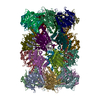

 thermoplasma acidophilum (acidophilic)