[English] 日本語
Yorodumi Papers
- Database of articles cited by EMDB/PDB/SASBDB data -

+
Search query

Keywords
Structure methods
Author
Journal
IF

-
Structure paper

TitleMechanism of human α3β GlyR regulation by intracellular M3/M4 loop phosphorylation and 2,6-di-tert-butylphenol interaction.
Journal, issue, pagesNat Commun, Vol. 16, Issue 1, Page 5242, Year 2025
Publish dateJun 5, 2025
AuthorsXiaofen Liu / Malgorzata Krezel / Weiwei Wang /
PubMed Abstractα3β glycine receptor (GlyR) is a subtype of GlyRs that belongs to the Cys-loop receptor superfamily. It is highly expressed in the spinal dorsal horn where sensory information is integrated. Under ...α3β glycine receptor (GlyR) is a subtype of GlyRs that belongs to the Cys-loop receptor superfamily. It is highly expressed in the spinal dorsal horn where sensory information is integrated. Under inflammatory conditions, the large unstructured intracellular M3/M4 loops of the α3 subunit are phosphorylated through the prostaglandin E2 (PGE) pathway, inhibiting ion conduction, and resulting in elevated pain sensation. A small molecule analgesic analog, 2,6-di-tert-butylphenol (2,6-DTBP) potentiates phosphorylated α3β GlyR through unclear mechanisms and relieves pain. Combining cryo-Electron Microscopy (cryo-EM) structures and single molecule Förster resonance energy transfer (smFRET) experiments, we show compaction of M3/M4 loop towards the ion conduction pore upon phosphorylation and further by 2,6-DTBP binding, which in turn modulates function through changing pore conformations and local electrostatics. We show that simultaneous interactions with the M3/M4 loop and the transmembrane domain (TM) is necessary for the potentiation of heteromeric α3β GlyR by 2,6-DTBP, while TM interaction alone is sufficient to potentiate homomeric α3 GlyR, explaining the mystery of why 2,6-DTBP potentiates only phosphorylated α3β GlyR. These findings show how post-translational modification of the unstructured intracellular M3/M4 loop may regulate Cys-loop receptor function, providing new perspectives in pain control and other pharmaceutical development targeting GlyRs and other Cys-loop receptors.
External linksNat Commun / PubMed:40473619 / PubMed Central
MethodsEM (single particle)
Resolution3.6 - 3.84 Å
Structure data

EMDB-44754, PDB-9boy:
Cryo-EM structure of human Glycine Receptor apha3-beta heteromer with glycine in nanodisc
Method: EM (single particle) / Resolution: 3.81 Å

EMDB-44755, PDB-9boz:
Cryo-EM structure of human Glycine Receptor alpha3-beta heteromer in presence of glycine
Method: EM (single particle) / Resolution: 3.84 Å

EMDB-44763, PDB-9bp7:
Cryo-EM structure of human heteromeric Glycine Receptor alpha3S346E-beta in presence of glycine and 2,6-DTBP
Method: EM (single particle) / Resolution: 3.6 Å

Chemicals

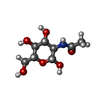
ChemComp-NAG:
2-acetamido-2-deoxy-beta-D-glucopyranose

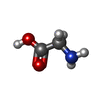
ChemComp-GLY:
GLYCINE

Source
  • homo sapiens (human)
KeywordsMEMBRANE PROTEIN / glycine receptor subunit alpha-3 / glycine receptor subunit beta / Green fluorescent protein

+
About Yorodumi Papers

-
News

-
Feb 9, 2022. New format data for meta-information of EMDB entries

New format data for meta-information of EMDB entries

  • Version 3 of the EMDB header file is now the official format.
  • The previous official version 1.9 will be removed from the archive.

Related info.:EMDB header

External links:wwPDB to switch to version 3 of the EMDB data model

-
Aug 12, 2020. Covid-19 info

Covid-19 info

URL: https://pdbj.org/emnavi/covid19.php

New page: Covid-19 featured information page in EM Navigator.

Related info.:Covid-19 info / Mar 5, 2020. Novel coronavirus structure data

+
Mar 5, 2020. Novel coronavirus structure data

Novel coronavirus structure data

Related info.:Yorodumi Speices / Aug 12, 2020. Covid-19 info

External links:COVID-19 featured content - PDBj / Molecule of the Month (242):Coronavirus Proteases

+
Jan 31, 2019. EMDB accession codes are about to change! (news from PDBe EMDB page)

EMDB accession codes are about to change! (news from PDBe EMDB page)

  • The allocation of 4 digits for EMDB accession codes will soon come to an end. Whilst these codes will remain in use, new EMDB accession codes will include an additional digit and will expand incrementally as the available range of codes is exhausted. The current 4-digit format prefixed with “EMD-” (i.e. EMD-XXXX) will advance to a 5-digit format (i.e. EMD-XXXXX), and so on. It is currently estimated that the 4-digit codes will be depleted around Spring 2019, at which point the 5-digit format will come into force.
  • The EM Navigator/Yorodumi systems omit the EMD- prefix.

Related info.:Q: What is EMD? / ID/Accession-code notation in Yorodumi/EM Navigator

External links:EMDB Accession Codes are Changing Soon! / Contact to PDBj

+
Jul 12, 2017. Major update of PDB

Major update of PDB

  • wwPDB released updated PDB data conforming to the new PDBx/mmCIF dictionary.
  • This is a major update changing the version number from 4 to 5, and with Remediation, in which all the entries are updated.
  • In this update, many items about electron microscopy experimental information are reorganized (e.g. em_software).
  • Now, EM Navigator and Yorodumi are based on the updated data.

External links:wwPDB Remediation / Enriched Model Files Conforming to OneDep Data Standards Now Available in the PDB FTP Archive

-
Yorodumi Papers

Database of articles cited by EMDB/PDB/SASBDB data

  • Database of articles cited by EMDB, PDB, and SASBDB entries
  • Using PubMed data

Related info.:EMDB / PDB / SASBDB / Yorodumi / EMN Papers / Changes in new EM Navigator and Yorodumi

Read more