 Movie
Movie Controller
 Structure viewers
 About Yorodumi Papers


+Search query
-Structure paper
| Title | Cryo-EM SPR structures of Salmonella typhimurium ArnC; the key enzyme in lipid-A modification conferring polymyxin resistance. |
|---|---|
| Journal, issue, pages | Protein Sci, Vol. 34, Issue 2, Page e70037, Year 2025 |
| Publish date | Jan 26, 2025 |
 Authors Authors | Dhruvin H Patel / Elina Karimullina / Yirui Guo / Cameron Semper / Deepak T Patel / Tabitha Emde / Dominika Borek / Alexei Savchenko /   |
| PubMed Abstract | Polymyxins are last-resort antimicrobial peptides administered clinically against multi-drug resistant bacteria, specifically in the case of Gram-negative species. However, an increasing number of ...Polymyxins are last-resort antimicrobial peptides administered clinically against multi-drug resistant bacteria, specifically in the case of Gram-negative species. However, an increasing number of these pathogens employ a defense strategy that involves a relay of enzymes encoded by the pmrE (ugd) loci and the arnBCDTEF operon. The pathway modifies the lipid-A component of the outer membrane (OM) lipopolysaccharide (LPS) by adding a 4-amino-4-deoxy-l-arabinose (L-Ara4N) headgroup, which renders polymyxins ineffective. Here, we report the cryo-EM SPR structures of glycosyltransferase ArnC from Salmonella typhimurium determined in apo and UDP-bound forms at resolutions 2.75 Å and 3.8 Å, respectively. The structure of the ArnC protomer comprises three distinct regions: an N-terminal glycosyltransferase domain, transmembrane region, and the interface helices (IHs). ArnC forms a tetramer with C2 symmetry, where the C-terminal strand inserts into the adjacent protomer. This tetrameric state is further stabilized by two distinct interfaces formed by ArnC that form a network of hydrogen bonds and salt bridges. The binding of UDP induces conformational changes that stabilize the loop between residues H201 to S213, and part of the putative catalytic pocket formed by IH1 and IH2. The surface property analysis revealed a hydrophobic cavity formed by TM1 and TM2 in the apo state, which is disrupted upon UDP binding. The comparison of ArnC structures to their homologs GtrB and DPMS suggests the key residues involved in ArnC catalytic activity. |
 External links External links | Protein Sci / PubMed:39865303 / PubMed Central |
| Methods | EM (single particle) |
| Resolution | 2.75 - 3.8 Å |
| Structure data | EMDB-44540, PDB-9bhc: EMDB-44542, PDB-9bhe: |
| Chemicals | 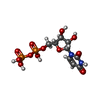 ChemComp-UDP: |
| Source |
|
 Keywords Keywords | MEMBRANE PROTEIN / transferase / glycolipid biosynthesis / Structural Genomics / Center for Structural Biology of Infectious Diseases / CSBID |


 salmonella enterica subsp. enterica serovar typhimurium (bacteria)