 Movie
Movie Controller
 Structure viewers
 About Yorodumi Papers


+Search query
-Structure paper
| Title | CX1/BtSY2 and BANAL-20-52 exhibit broader receptor binding and higher affinities to multiple animal ACE2 orthologs than SARS-CoV-2 prototype. |
|---|---|
| Journal, issue, pages | J Virol, Vol. 99, Issue 8, Page e0028325, Year 2025 |
| Publish date | Aug 19, 2025 |
 Authors Authors | Zepeng Xu / Linjie Li / Yuhang Gu / Dedong Li / Jianxun Qi / Kefang Liu / Chu-Xia Deng / George Fu Gao /  |
| PubMed Abstract | Animal coronaviruses (CoVs) CX1 (formerly named BtSY2) and BANAL-20-52 are phylogenetically closely related to severe acute respiratory syndrome coronavirus 2 (SARS-CoV-2), and CX1 is the first ...Animal coronaviruses (CoVs) CX1 (formerly named BtSY2) and BANAL-20-52 are phylogenetically closely related to severe acute respiratory syndrome coronavirus 2 (SARS-CoV-2), and CX1 is the first observed animal betaCoV carrying naturally occurring Y501 in its receptor-binding domain (RBD) of the spike (S) protein, a residue related to human adaptation and broader host range. We evaluated the ACE2 usage of CX1 and BANAL-20-52 and observed broader receptor binding spectra and higher affinities to most of the tested animal ACE2 orthologs than the SARS-CoV-2 prototype. Determination of the cryo-EM structures of their S proteins and RBD/hACE2 complexes reveals that Y501 is inter-replaceable with H498 substitution while synergetic with R498 for human ACE2 binding. These results provide further structural insights into SARS-CoV-2 receptor recognition and address the importance of surveillance on potential emerging CoVs.IMPORTANCESince the outbreak of COVID-19, forewarning and prevention of the next pandemic have been widely discussed. Coronaviruses (CoVs) CX1 (formerly named BtSY2) and BANAL-20-52 are phylogenetically closely related to SARS-CoV-2. Particularly, CX1 is the first SARS-CoV-2-related CoV containing Y501 in its receptor-binding domain (RBD) of the spike (S) protein. This study evaluated the interspecies transmission potential of the two CoVs and structurally elucidated the interplay between two RBD residues 498 and 501 on ACE2 binding, further highlighting the importance of surveillance on zoonotic CoVs. |
 External links External links | J Virol / PubMed:40637421 / PubMed Central |
| Methods | EM (single particle) |
| Resolution | 2.5 - 3.04 Å |
| Structure data | EMDB-38773, PDB-8xyh: EMDB-38778, PDB-8xym: EMDB-38779, PDB-8xyo: |
| Chemicals | 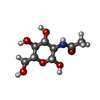 ChemComp-NAG:  ChemComp-EIC:  ChemComp-ZN: |
| Source |
|
 Keywords Keywords | VIRAL PROTEIN / BANAL-20-52 / spike protein / CX1 / HYDROLASE/VIRAL PROTEIN / receptor binding domain / human ACE2 / HYDROLASE-VIRAL PROTEIN complex |


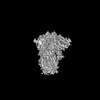



 coronavirinae (virus)
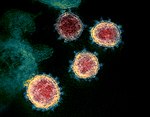 severe acute respiratory syndrome coronavirus 2
 homo sapiens (human)