 Movie
Movie Controller
 Structure viewers
 About Yorodumi Papers


+Search query
-Structure paper
| Title | Cryo-EM structure of N-glycosylated Pomacea canaliculata hemocyanin provides insights into its role in the immune response of gastropods. |
|---|---|
| Journal, issue, pages | FEBS J, Vol. 293, Issue 9, Page 2708-2731, Year 2026 |
| Publish date | Dec 26, 2025 |
 Authors Authors | Tabata Romina Brola / Ignacio Rafael Chiumiento / Santiago Ituarte / Guillermo Ignacio Benítez / Marcos Gragera / Jose-Maria Carazo / Horacio Heras / Lisandro Horacio Otero / Marcos Sebastián Dreon /   |
| PubMed Abstract | Hemocyanins are multifunctional soluble proteins found in most mollusks and some arthropods that may turn into a phenoloxidase-like enzyme (PO) associated with innate immune functions. To expand the ...Hemocyanins are multifunctional soluble proteins found in most mollusks and some arthropods that may turn into a phenoloxidase-like enzyme (PO) associated with innate immune functions. To expand the structural understanding of gastropod hemocyanins and their physiological implications, here we report the single-particle cryogenic electron microscopy (cryo-EM) structure of Pomacea canaliculata snail hemocyanin (PcH) at 4.4 Å resolution along with its intrinsic and proteolytically induced PO activity. PcH shows a Megathura crenulata (giant keyhole limpet) hemocyanin (KLH)-type structure with a cylindrical shape, comprising 20 protomers assembled as di-pentamers of antiparallel asymmetric dimers, organized in a D5 symmetry. Each protomer comprises eight paralogous functional units (FUs) sharing conserved structural features typical of hemocyanins. The achieved map resolution allowed delineation of interaction networks among adjacent subunits across quaternary structure tiers-dimer, pentamer of dimers (decamer), and di-pentamer of dimers (di-decamer). Additionally, we identified six N-glycosylation sites per protomer, totaling 120 glycan trees in the overall structure. Kinetic analysis of intrinsic PO activity using catechol as substrate revealed a Michaelis constant (K) of 45.3 mm and a catalytic rate constant (k) of 2.87 min. This specific activity was enhanced by limited proteolysis using digestive and bacterial proteases. Potential protease cleavage sites were identified in silico, mapped onto the PcH model, and their accessibility assessed. Combined with molecular dynamics simulations, these findings suggest a structural basis for the PO induction mechanism. This study expands our knowledge of KLH-type hemocyanins and provides clues into their PO activation, which is triggered by endogenous and/or pathogen-associated proteases. This further underscores the role of molluscan hemocyanins in the innate immune system. |
 External links External links | FEBS J / PubMed:41454440 |
| Methods | EM (single particle) |
| Resolution | 4.4 Å |
| Structure data | EMDB-41586, PDB-8trz: |
| Chemicals | 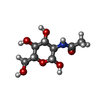 ChemComp-NAG: |
| Source |
|
 Keywords Keywords | OXYGEN TRANSPORT / Glycoprotein / Respiratory Pigment / Cooper Protein / Carbohydrates |


 pomacea canaliculata (invertebrata)