[English] 日本語
Yorodumi Papers
- Database of articles cited by EMDB/PDB/SASBDB data -

+
Search query

Keywords
Structure methods
Author
Journal
IF

-
Structure paper

TitleStructural basis of sensory receptor evolution in octopus.
Journal, issue, pagesNature, Vol. 616, Issue 7956, Page 373-377, Year 2023
Publish dateApr 12, 2023
AuthorsCorey A H Allard / Guipeun Kang / Jeong Joo Kim / Wendy A Valencia-Montoya / Ryan E Hibbs / Nicholas W Bellono /
PubMed AbstractChemotactile receptors (CRs) are a cephalopod-specific innovation that allow octopuses to explore the seafloor via 'taste by touch'. CRs diverged from nicotinic acetylcholine receptors to mediate ...Chemotactile receptors (CRs) are a cephalopod-specific innovation that allow octopuses to explore the seafloor via 'taste by touch'. CRs diverged from nicotinic acetylcholine receptors to mediate contact-dependent chemosensation of insoluble molecules that do not readily diffuse in marine environments. Here we exploit octopus CRs to probe the structural basis of sensory receptor evolution. We present the cryo-electron microscopy structure of an octopus CR and compare it with nicotinic receptors to determine features that enable environmental sensation versus neurotransmission. Evolutionary, structural and biophysical analyses show that the channel architecture involved in cation permeation and signal transduction is conserved. By contrast, the orthosteric ligand-binding site is subject to diversifying selection, thereby mediating the detection of new molecules. Serendipitous findings in the cryo-electron microscopy structure reveal that the octopus CR ligand-binding pocket is exceptionally hydrophobic, enabling sensation of greasy compounds versus the small polar molecules detected by canonical neurotransmitter receptors. These discoveries provide a structural framework for understanding connections between evolutionary adaptations at the atomic level and the emergence of new organismal behaviour.
External linksNature / PubMed:37045920 / PubMed Central
MethodsEM (single particle)
Resolution2.62 Å
Structure data

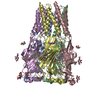
EMDB-28163: Cryo-EM map of octopus sensory receptor CRT1
PDB-8eis: Cryo-EM structure of octopus sensory receptor CRT1
Method: EM (single particle) / Resolution: 2.62 Å

Chemicals

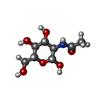
ChemComp-NAG:
2-acetamido-2-deoxy-beta-D-glucopyranose

ChemComp-DU0:
2-[2-[(1~{S},2~{S},4~{S},5'~{R},6~{R},7~{S},8~{R},9~{S},12~{S},13~{R},16~{S})-5',7,9,13-tetramethylspiro[5-oxapentacyclo[10.8.0.0^{2,9}.0^{4,8}.0^{13,18}]icos-18-ene-6,2'-oxane]-16-yl]oxyethyl]propane-1,3-diol

Source
  • octopus bimaculoides (California two-spot octopus)

KeywordsSTRUCTURAL PROTEIN / pentameric ligand gated ion channel / octopus sensory receptor / cys-loop receptor

+
About Yorodumi Papers

-
News

-
Feb 9, 2022. New format data for meta-information of EMDB entries

New format data for meta-information of EMDB entries

  • Version 3 of the EMDB header file is now the official format.
  • The previous official version 1.9 will be removed from the archive.

Related info.:EMDB header

External links:wwPDB to switch to version 3 of the EMDB data model

-
Aug 12, 2020. Covid-19 info

Covid-19 info

URL: https://pdbj.org/emnavi/covid19.php

New page: Covid-19 featured information page in EM Navigator.

Related info.:Covid-19 info / Mar 5, 2020. Novel coronavirus structure data

+
Mar 5, 2020. Novel coronavirus structure data

Novel coronavirus structure data

Related info.:Yorodumi Speices / Aug 12, 2020. Covid-19 info

External links:COVID-19 featured content - PDBj / Molecule of the Month (242):Coronavirus Proteases

+
Jan 31, 2019. EMDB accession codes are about to change! (news from PDBe EMDB page)

EMDB accession codes are about to change! (news from PDBe EMDB page)

  • The allocation of 4 digits for EMDB accession codes will soon come to an end. Whilst these codes will remain in use, new EMDB accession codes will include an additional digit and will expand incrementally as the available range of codes is exhausted. The current 4-digit format prefixed with “EMD-” (i.e. EMD-XXXX) will advance to a 5-digit format (i.e. EMD-XXXXX), and so on. It is currently estimated that the 4-digit codes will be depleted around Spring 2019, at which point the 5-digit format will come into force.
  • The EM Navigator/Yorodumi systems omit the EMD- prefix.

Related info.:Q: What is EMD? / ID/Accession-code notation in Yorodumi/EM Navigator

External links:EMDB Accession Codes are Changing Soon! / Contact to PDBj

+
Jul 12, 2017. Major update of PDB

Major update of PDB

  • wwPDB released updated PDB data conforming to the new PDBx/mmCIF dictionary.
  • This is a major update changing the version number from 4 to 5, and with Remediation, in which all the entries are updated.
  • In this update, many items about electron microscopy experimental information are reorganized (e.g. em_software).
  • Now, EM Navigator and Yorodumi are based on the updated data.

External links:wwPDB Remediation / Enriched Model Files Conforming to OneDep Data Standards Now Available in the PDB FTP Archive

-
Yorodumi Papers

Database of articles cited by EMDB/PDB/SASBDB data

  • Database of articles cited by EMDB, PDB, and SASBDB entries
  • Using PubMed data

Related info.:EMDB / PDB / SASBDB / Yorodumi / EMN Papers / Changes in new EM Navigator and Yorodumi

Read more