 Movie
Movie Controller
 Structure viewers
 About Yorodumi Papers


+Search query
-Structure paper
| Title | ADP-Bound States of Cytoplasmic Dynein: Cryo-electron Microscopy Reveals a Two-Step Post-Power-Stroke Transition and Roles of Regulatory ATPase Sites. |
|---|---|
| Journal, issue, pages | J Mol Biol, Vol. 438, Issue 21, Page 169977, Year 2026 |
| Publish date | Aug 6, 2026 |
 Authors Authors | Hiroshi Imai / Riko Kanazawa / Toshihisa Maeshima / Duy Phuoc Tran / Rieko Shimo-Kon / Hisaya Tokita / Tomoko Miyata / Fumiaki Makino / Junso Fujita / Takayuki Kato / Akio Kitao / Keiichi Namba / Takahide Kon /  |
| PubMed Abstract | Cytoplasmic dynein is essential for intracellular transport and cell division, and its dysfunction is implicated in severe neurological disorders. Its motility is driven by the primary ATPase site in ...Cytoplasmic dynein is essential for intracellular transport and cell division, and its dysfunction is implicated in severe neurological disorders. Its motility is driven by the primary ATPase site in the AAA1 module and allosterically modulated by regulatory ATPase sites in the AAA3 and AAA4 modules. Despite recent structural advances, post-force-generating (post-power-stroke) transitions and the structural basis of AAA3/AAA4-mediated regulation remain elusive. Using cryo-electron microscopy, we captured intermediate structures of Dictyostelium discoideum cytoplasmic dynein. We identified two distinct ADP-bound states and two apo states, the latter comprising a partially nucleotide-free state with ADP retained at the AAA3 and AAA4 ATPase sites and a fully nucleotide-free state. For the AAA1 ATPase site, our structures and molecular dynamics simulations suggest a dynamic equilibrium between two ADP-bound states. In this model, linker swing and docking onto the AAA5 module can be driven by thermal fluctuations while ADP remains bound at the AAA1 ATPase site, shifting the motor from a canonical ADP-bound state to a metastable apo-like conformation with reduced ADP affinity. This transition could provide a framework for tension-sensing coordination. For the AAA3 and AAA4 ATPase sites, comparison of the partially and fully nucleotide-free apo structures indicates that ADP release induces localized outward tilting of the corresponding large submodules. We propose that this rearrangement displaces the AAA4 Pre-Sensor-I insert from the linker, thereby disfavoring the recovery stroke and stabilizing an inactive state. Together, our findings provide a mechanistic model in which coordinated conformational dynamics across multiple ATPase sites govern dynein's chemomechanical cycle. |
 External links External links | J Mol Biol / PubMed:42562341 |
| Methods | EM (single particle) |
| Resolution | 2.2 - 3.2 Å |
| Structure data | EMDB-81330, PDB-27pt: EMDB-81335, PDB-27py: EMDB-81336, PDB-27pz: EMDB-81337, PDB-27qa: EMDB-81338, PDB-27qb: |
| Chemicals | 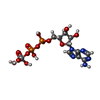 ChemComp-AOV:  ChemComp-MG: 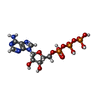 ChemComp-ATP: 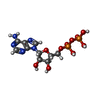 ChemComp-ADP: |
| Source |
|
 Keywords Keywords | MOTOR PROTEIN / dynein / ATPase / AAA+ protein |


 dictyostelium discoideum ax2 (eukaryote)