[English] 日本語
Yorodumi Papers
- Database of articles cited by EMDB/PDB/SASBDB data -

+
Search query

Keywords
Structure methods
Author
Journal
IF

-
Structure paper

TitleStructure and dynamics of a four-protofilament microtubule from Heimdallarchaeales α/β-tubulin.
Journal, issue, pagesSci Adv, Vol. 12, Issue 29, Page eaeh4305, Year 2026
Publish dateJul 17, 2026
AuthorsLinh T Tran / Samson Ali / Tomoharu Matsumoto / Yosuke Yamazaki / Akihiro Narita / Makito Miyazaki / Robert C Robinson /
PubMed AbstractEukaryotic microtubules are typically 13-protofilament tubes assembled from α/β-tubulin heterodimers that combine mechanical rigidity with dynamic instability. Homologous tubulins have been ...Eukaryotic microtubules are typically 13-protofilament tubes assembled from α/β-tubulin heterodimers that combine mechanical rigidity with dynamic instability. Homologous tubulins have been identified in Asgard archaea, the closest prokaryotic relatives to eukaryotes. Here, we characterize a heterodimeric α/β-tubulin system from Heimdallarchaeales. Biochemical reconstitution shows that α/β-tubulin forms a heterodimer that undergoes guanosine 5'-triphosphate-dependent polymerization with coupled nucleotide hydrolysis. Cryo-electron microscopy reveals that the polymers are composed of four-protofilament tubules, with microtubule-like lattices formed by conserved longitudinal interfaces and ball-and-socket lateral contacts. Single-filament imaging demonstrates intrinsic kinetic polarity and dynamic instability, while liposome encapsulation shows that microtubule growth generates forces sufficient to deform membranes. Despite their reduced protofilament number, -α/β-microtubules share key structural and dynamic features with eukaryotic microtubules but exhibit lower bending stiffness and polymerization force. Thus, microtubule-like polymers can form from a range of protofilament numbers, with reduced architectures potentially adapted to small cellular dimensions and lower mechanical loads. Together, our results indicate expansion in microtubule protofilament number during eukaryogenesis.
External linksSci Adv / PubMed:42455893 / PubMed Central
MethodsEM (helical sym.)
Resolution2.4 - 3.9 Å
Structure data

EMDB-69801, PDB-24sv:
Averaged protofilament of Heimdallarchaeales alpha/beta tubulin microtubule with a single seam
Method: EM (helical sym.) / Resolution: 2.4 Å

EMDB-69802, PDB-24sw:
Heimdallarchaeales alpha/beta tubulin microtubule with three seams
Method: EM (helical sym.) / Resolution: 3.9 Å

Chemicals

ChemComp-GDP:
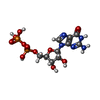
GUANOSINE-5'-DIPHOSPHATE / GDP, energy-carrying molecule*YM

ChemComp-MG:
Unknown entry

Source
  • candidatus heimdallarchaeaceae (archaea)

KeywordsPROTEIN FIBRIL / Heimdallarchaea tubulin microtubule archaea

+
About Yorodumi Papers

-
News

-
Feb 9, 2022. New format data for meta-information of EMDB entries

New format data for meta-information of EMDB entries

  • Version 3 of the EMDB header file is now the official format.
  • The previous official version 1.9 will be removed from the archive.

Related info.:EMDB header

External links:wwPDB to switch to version 3 of the EMDB data model

-
Aug 12, 2020. Covid-19 info

Covid-19 info

URL: https://pdbj.org/emnavi/covid19.php

New page: Covid-19 featured information page in EM Navigator.

Related info.:Covid-19 info / Mar 5, 2020. Novel coronavirus structure data

+
Mar 5, 2020. Novel coronavirus structure data

Novel coronavirus structure data

Related info.:Yorodumi Speices / Aug 12, 2020. Covid-19 info

External links:COVID-19 featured content - PDBj / Molecule of the Month (242):Coronavirus Proteases

+
Jan 31, 2019. EMDB accession codes are about to change! (news from PDBe EMDB page)

EMDB accession codes are about to change! (news from PDBe EMDB page)

  • The allocation of 4 digits for EMDB accession codes will soon come to an end. Whilst these codes will remain in use, new EMDB accession codes will include an additional digit and will expand incrementally as the available range of codes is exhausted. The current 4-digit format prefixed with “EMD-” (i.e. EMD-XXXX) will advance to a 5-digit format (i.e. EMD-XXXXX), and so on. It is currently estimated that the 4-digit codes will be depleted around Spring 2019, at which point the 5-digit format will come into force.
  • The EM Navigator/Yorodumi systems omit the EMD- prefix.

Related info.:Q: What is EMD? / ID/Accession-code notation in Yorodumi/EM Navigator

External links:EMDB Accession Codes are Changing Soon! / Contact to PDBj

+
Jul 12, 2017. Major update of PDB

Major update of PDB

  • wwPDB released updated PDB data conforming to the new PDBx/mmCIF dictionary.
  • This is a major update changing the version number from 4 to 5, and with Remediation, in which all the entries are updated.
  • In this update, many items about electron microscopy experimental information are reorganized (e.g. em_software).
  • Now, EM Navigator and Yorodumi are based on the updated data.

External links:wwPDB Remediation / Enriched Model Files Conforming to OneDep Data Standards Now Available in the PDB FTP Archive

-
Yorodumi Papers

Database of articles cited by EMDB/PDB/SASBDB data

  • Database of articles cited by EMDB, PDB, and SASBDB entries
  • Using PubMed data

Related info.:EMDB / PDB / SASBDB / Yorodumi / EMN Papers / Changes in new EM Navigator and Yorodumi

Read more