 Movie
Movie Controller
 Structure viewers
 About Yorodumi Papers


+Search query
-Structure paper
| Title | Structural basis of influenza A virus neutralization by broadly reactive single-domain antibody G2.3 recognizing glycosylated epitope within hemagglutinin stem domain. |
|---|---|
| Journal, issue, pages | Int J Biol Macromol, Vol. 372, Page 152701, Year 2026 |
| Publish date | May 25, 2026 |
 Authors Authors | Igor O Ilyasov / Daria V Voronina / Timur N Baymukhametov / Ivan I Vorobiev / Ekaterina I Ryabova / Artem A Derkaev / Ilias B Esmagambetov / Maxim M Shmarov / Yulia A Khodak / Anna D Burtseva / Nikolai N Sluchanko / Konstantin M Boyko / Dmitry V Shcheblyakov / Aleksandr L Gintsburg / Vladimir O Popov / Denis Y Logunov /  |
| PubMed Abstract | Influenza remains one of the most common and contagious respiratory infections causing around a billion cases of seasonal illness annually and five million cases of severe consequences. A recently ...Influenza remains one of the most common and contagious respiratory infections causing around a billion cases of seasonal illness annually and five million cases of severe consequences. A recently reported G2.3 antibody exhibited a potent cross-subtype activity against Group 1 influenza A viruses. Here, we shed light on the structural basis of the broad neutralizing activity of G2.3 by using cryoEM. Structural analysis of the G2.3 complex with H1 hemagglutinin revealed a partly conserved epitope located on the stem domain. The structural data were confirmed by the assessment of binding and neutralizing properties of the Fc-modified form of G2.3 with a broad panel of recombinant hemagglutinins and influenza A viruses. We demonstrated remarkably high activity of G2.3-Fc against H1N1 viral strains, which is consistent with G2.3 epitope being the most conserved within the H1 subtype, but low activity towards Group 2 of HA, which was explained by the analysis of the epitope. To suggest the mechanism of G2.3 neutralization, we compared its epitope with those of other broadly neutralizing antibodies that attack the stem domain. Finally, we obtained an escape mutant that has two mutations within the epitope and in its vicinity, unseen in circulating H1 strains, allowing this mutant to elude from G2.3 and made assumption of the mechanism of such evasion. |
 External links External links | Int J Biol Macromol / PubMed:42190777 |
| Methods | EM (single particle) |
| Resolution | 2.53 Å |
| Structure data | EMDB-69590, PDB-24kr: |
| Chemicals | 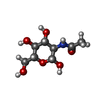 ChemComp-NAG: |
| Source |
|
 Keywords Keywords | ANTIVIRAL PROTEIN / hemagglutinin / influenza A / H1N1 / antibody / G2.3 / cryoEM / stem domain |


 influenza a virus (a/california/04/2009(h1n1))