 Movie
Movie Controller
 Structure viewers
 About Yorodumi Papers


+Search query
-Structure paper
| Title | Hydrophobic pore gates regulate ion permeation in polycystic kidney disease 2 and 2L1 channels. |
|---|---|
| Journal, issue, pages | Nat Commun, Vol. 9, Issue 1, Page 2302, Year 2018 |
| Publish date | Jun 13, 2018 |
 Authors Authors | Wang Zheng / Xiaoyong Yang / Ruikun Hu / Ruiqi Cai / Laura Hofmann / Zhifei Wang / Qiaolin Hu / Xiong Liu / David Bulkley / Yong Yu / Jingfeng Tang / Veit Flockerzi / Ying Cao / Erhu Cao / Xing-Zhen Chen /     |
| PubMed Abstract | PKD2 and PKD1 genes are mutated in human autosomal dominant polycystic kidney disease. PKD2 can form either a homomeric cation channel or a heteromeric complex with the PKD1 receptor, presumed to ...PKD2 and PKD1 genes are mutated in human autosomal dominant polycystic kidney disease. PKD2 can form either a homomeric cation channel or a heteromeric complex with the PKD1 receptor, presumed to respond to ligand(s) and/or mechanical stimuli. Here, we identify a two-residue hydrophobic gate in PKD2L1, and a single-residue hydrophobic gate in PKD2. We find that a PKD2 gain-of-function gate mutant effectively rescues PKD2 knockdown-induced phenotypes in embryonic zebrafish. The structure of a PKD2 activating mutant F604P by cryo-electron microscopy reveals a π- to α-helix transition within the pore-lining helix S6 that leads to repositioning of the gate residue and channel activation. Overall the results identify hydrophobic gates and a gating mechanism of PKD2 and PKD2L1. |
 External links External links | Nat Commun / PubMed:29899465 / PubMed Central |
| Methods | EM (single particle) |
| Resolution | 3.54 Å |
| Structure data | |
| Chemicals | 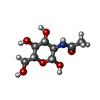 ChemComp-NAG: |
| Source |
|
 Keywords Keywords | TRANSPORT PROTEIN / Ion Channel / TRP channel / PKD2 / PC2 / TRPP2 |


 homo sapiens (human)