 Movie
Movie Controller
 Structure viewers
 About Yorodumi Papers


+Search query
-Structure paper
| Title | Cryo-EM study of bacteriophage N4 virion RNA polymerase. |
|---|---|
| Journal, issue, pages | J Bacteriol, Page e0020826, Year 2026 |
| Publish date | Jul 27, 2026 |
 Authors Authors | Manju Narwal / Yeonoh Shin / Katsuhiko S Murakami /  |
| PubMed Abstract | Coliphage N4 employs a unique infection and transcription strategy in which early gene expression is driven by a virion-encapsidated RNA polymerase (vRNAP) that is injected into the host cytoplasm ...Coliphage N4 employs a unique infection and transcription strategy in which early gene expression is driven by a virion-encapsidated RNA polymerase (vRNAP) that is injected into the host cytoplasm upon infection. Despite extensive biochemical and crystallographic studies of the polymerase domain of vRNAP, the structural organization and regulatory roles of the N-terminal domain (NTD) and C-terminal domain (CTD) regions of the 3,500-residue-long whole enzyme have remained unresolved. Here, we report the cryo-electron microscopy (cryo-EM) structures of full-length N4 vRNAP in its apo state and in a transcription initiation complex (TIC) with promoter DNA and initiating nucleotides. The apo structure reveals a modular architecture in which an α-helical CTD packs against the Pol domain to stabilize an autoinhibited conformation characterized by occlusion of the nucleotide-binding site through tight contact between the plug module and motif B loop. In contrast, promoter binding induces conformational rearrangements that displace the motif B loop from the active site and separate the CTD from the Pol domain. The NTD is unresolved in both states, consistent with substantial intrinsic flexibility, and supporting its proposed role in membrane association and genome injection. Structural modeling suggests that domain segmentation and conformational plasticity may enable translocation of vRNAP through the ~30 Å wide phage tail channel during infection. Together, these results define the molecular architecture of full-length vRNAP and establish a structural framework for understanding how the conformational transition of vRNAP is coupled to its ejection, DNA injection, and early gene expression.IMPORTANCEThis study investigates the structure of full-length bacteriophage N4 virion RNA polymerase (vRNAP), one of the largest known single-subunit RNA polymerases. The functions of its extensive N- and C-terminal regions remained unknown. Our work uncovers how the C-terminal domain regulates polymerase activity through a structural "switch" that locks the enzyme in an inactive state until it recognizes its promoter DNA. These findings explain how the phage prevents premature transcription and ensures precise control of early gene expression during infection. By integrating structures with the architecture of the N4 phage particle, we propose a mechanism by which this vRNAP is transported through the narrow phage tail into the host cell. Together, this work provides fundamental insight into phage transcription and viral gene regulation. |
 External links External links | J Bacteriol / PubMed:42505119 |
| Methods | EM (single particle) |
| Resolution | 2.82 - 3.43 Å |
| Structure data | EMDB-75669, PDB-11fw: EMDB-75680, PDB-11go: EMDB-75681, PDB-11gp: |
| Chemicals | 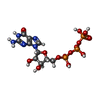 ChemComp-GTP:  ChemComp-MG: |
| Source |
|
 Keywords Keywords | VIRAL PROTEIN / N4 phage viral RNA polymerase / N4 Bacteriophage vRNAP / Bacteriophage N4 phage vRNAP protein |


 escherichia phage n4 (virus)