[English] 日本語
Yorodumi Papers
- Database of articles cited by EMDB/PDB/SASBDB data -

+
Search query

Keywords
Structure methods
Author
Journal
IF

-
Structure paper

TitleStructural insights into HSV-1 origin unwinding by the viral proteins UL9 and ICP8.
Journal, issue, pagesNucleic Acids Res, Vol. 54, Issue 11, Year 2026
Publish dateJun 8, 2026
AuthorsAndrey G Baranovskiy / Lucia M Morstadt / Eduardo E Romero / Nigar D Babayeva / Tahir H Tahirov /
PubMed AbstractHerpes simplex virus type 1 (HSV-1) causes lifelong infections in human cells and is associated with a range of diseases. HSV-1 DNA replication requires seven viral proteins, including the major DNA- ...Herpes simplex virus type 1 (HSV-1) causes lifelong infections in human cells and is associated with a range of diseases. HSV-1 DNA replication requires seven viral proteins, including the major DNA-binding protein ICP8, the origin-binding protein UL9, and proteins that comprise the helicase-primase and DNA polymerase complexes. UL9 functions as a DNA helicase that specifically recognizes and binds to the viral origins of replication, OriS and OriL. Here we report the cryo-EM structure of the UL9/ICP8/DNA/ATPγS complex at an overall resolution of 3.18 Å. This structure revealed that UL9 employs an α-helix to separate the DNA strands and captures the initial step of OriS unwinding, in which the C-terminal domain of UL9 specifically binds to the major groove of a DNA double helix, while the N-terminal helicase domain engages the unwound leading and lagging strands. ICP8 interacts with the extreme C-terminal region of UL9, preventing UL9 dimerization. Simultaneously, it binds and stabilizes the leading-strand DNA adjacent to UL9. Together, these findings provide mechanistic insight into UL9-driven DNA unwinding and the cooperative action of UL9 and ICP8 at HSV-1 replication origins, establishing a structural framework for the rational interpretation of prior biochemical data and for the design of new antiviral drugs.
External linksNucleic Acids Res / PubMed:42283126 / PubMed Central
MethodsEM (single particle)
Resolution3.1 - 3.2 Å
Structure data

EMDB-74143: The sharpened consensus map for UL9-ICP8-DNA complex
Method: EM (single particle) / Resolution: 3.18 Å

EMDB-74144: The focused map for ICP8-DNA
Method: EM (single particle) / Resolution: 3.2 Å

EMDB-74145: The focused map for UL9-DNA
Method: EM (single particle) / Resolution: 3.2 Å

EMDB-74190, PDB-9zgf:
The complex of HSV-1 proteins UL9 and ICP8 with forked DNA
Method: EM (single particle) / Resolution: 3.1 Å

Chemicals

ChemComp-ZN:
Unknown entry

ChemComp-MG:
Unknown entry

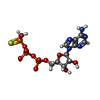
ChemComp-AGS:
PHOSPHOTHIOPHOSPHORIC ACID-ADENYLATE ESTER / ATP-gamma-S, energy-carrying molecule analogue*YM

Source
  • human alphaherpesvirus 1 strain 17
KeywordsREPLICATION/DNA / DNA replication / protein-DNA complex / REPLICATION-DNA complex

+
About Yorodumi Papers

-
News

-
Feb 9, 2022. New format data for meta-information of EMDB entries

New format data for meta-information of EMDB entries

  • Version 3 of the EMDB header file is now the official format.
  • The previous official version 1.9 will be removed from the archive.

Related info.:EMDB header

External links:wwPDB to switch to version 3 of the EMDB data model

-
Aug 12, 2020. Covid-19 info

Covid-19 info

URL: https://pdbj.org/emnavi/covid19.php

New page: Covid-19 featured information page in EM Navigator.

Related info.:Covid-19 info / Mar 5, 2020. Novel coronavirus structure data

+
Mar 5, 2020. Novel coronavirus structure data

Novel coronavirus structure data

Related info.:Yorodumi Speices / Aug 12, 2020. Covid-19 info

External links:COVID-19 featured content - PDBj / Molecule of the Month (242):Coronavirus Proteases

+
Jan 31, 2019. EMDB accession codes are about to change! (news from PDBe EMDB page)

EMDB accession codes are about to change! (news from PDBe EMDB page)

  • The allocation of 4 digits for EMDB accession codes will soon come to an end. Whilst these codes will remain in use, new EMDB accession codes will include an additional digit and will expand incrementally as the available range of codes is exhausted. The current 4-digit format prefixed with “EMD-” (i.e. EMD-XXXX) will advance to a 5-digit format (i.e. EMD-XXXXX), and so on. It is currently estimated that the 4-digit codes will be depleted around Spring 2019, at which point the 5-digit format will come into force.
  • The EM Navigator/Yorodumi systems omit the EMD- prefix.

Related info.:Q: What is EMD? / ID/Accession-code notation in Yorodumi/EM Navigator

External links:EMDB Accession Codes are Changing Soon! / Contact to PDBj

+
Jul 12, 2017. Major update of PDB

Major update of PDB

  • wwPDB released updated PDB data conforming to the new PDBx/mmCIF dictionary.
  • This is a major update changing the version number from 4 to 5, and with Remediation, in which all the entries are updated.
  • In this update, many items about electron microscopy experimental information are reorganized (e.g. em_software).
  • Now, EM Navigator and Yorodumi are based on the updated data.

External links:wwPDB Remediation / Enriched Model Files Conforming to OneDep Data Standards Now Available in the PDB FTP Archive

-
Yorodumi Papers

Database of articles cited by EMDB/PDB/SASBDB data

  • Database of articles cited by EMDB, PDB, and SASBDB entries
  • Using PubMed data

Related info.:EMDB / PDB / SASBDB / Yorodumi / EMN Papers / Changes in new EM Navigator and Yorodumi

Read more