 Movie
Movie Controller
 Structure viewers
 About Yorodumi Papers


+Search query
-Structure paper
| Title | Structural basis of the inhibition of TRPV1 by analgesic sesquiterpenes. |
|---|---|
| Journal, issue, pages | Proc Natl Acad Sci U S A, Vol. 122, Issue 29, Page e2506560122, Year 2025 |
| Publish date | Jul 22, 2025 |
 Authors Authors | Raúl Sánchez-Hernández / Miguel Benítez-Angeles / Irina A Talyzina / Itzel Llorente / Mariela González-Avendaño / Félix Sierra / Angélica Méndez-Reséndiz / Francisco Mercado / Ariela Vergara-Jaque / Alexander I Sobolevsky / León D Islas / Tamara Rosenbaum /    |
| PubMed Abstract | The Transient Receptor Potential Vanilloid 1 (TRPV1) ion channel is expressed in primary nociceptive afferents, which participate in processes such as pain and inflammation. Considerable efforts have ...The Transient Receptor Potential Vanilloid 1 (TRPV1) ion channel is expressed in primary nociceptive afferents, which participate in processes such as pain and inflammation. Considerable efforts have been directed toward finding inhibitors of TRPV1 and understanding the molecular details of their interactions with this channel. α-humulene (AH) is a sesquiterpene derived from plants such as hops and other members of Cannabaceae family, with a long history of popular use as an analgesic and anti-inflammatory. Using a combination of behavioral assays, electrophysiology, site-directed mutagenesis, cryo-EM, and molecular dynamics simulations, we show that AH inhibits TRPV1-related pain responses and currents by interacting with a region composed of the S2, S2-S3 linker, and S3 transmembrane segments and stabilizing the closed conformation of the channel. The interaction of ligands in this region of the TRPV1 channel has not been previously described and the results of the present study highlight that it may constitute part of a negative regulatory region. These findings allow us to understand the molecular basis by which substances such as some sesquiterpenes, abundantly found in medicinal plants used by humans for hundreds of years, reduce pain. Pain management can include the use of opioids, which results in hepatic and renal damage and possible addiction. Our study offers insight into a poorly understood group of compounds that could be used as scaffold to produce novel nonopioid analgesic therapies and clarifies the molecular mechanisms that underlie the effects of these analgesic molecules. |
 External links External links | Proc Natl Acad Sci U S A / PubMed:40663614 / PubMed Central |
| Methods | EM (single particle) |
| Resolution | 2.74 Å |
| Structure data | EMDB-71303, PDB-9p6b: |
| Chemicals | 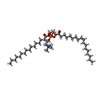 ChemComp-POV: 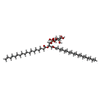 ChemComp-8IJ: 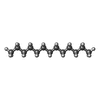 ChemComp-TRD:  ChemComp-NA:  ChemComp-HOH: |
| Source |
|
 Keywords Keywords | MEMBRANE PROTEIN / transient receptor potential V family member 1 / TRP / channel / TRPV1 / TRP channels / sesquiterpene / alpha-humulene / pain / analgesia |

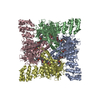
 homo sapiens (human)