 Movie
Movie Controller
 Structure viewers
 About Yorodumi Papers


+Search query
-Structure paper
| Title | Structure of the mouse cytoplasmic lattice. |
|---|---|
| Journal, issue, pages | Nature, Vol. 654, Issue 8118, Page 523-531, Year 2026 |
| Publish date | Mar 31, 2026 |
 Authors Authors | Pengliang Chi / Xiang Wang / Jialu Li / Jingrui Huang / Sicheng Ju / Sibei Liu / Li Yan / Yuechao Lu / Zihan Zhang / Zhuo Han / Jinhong Li / Qianqian Qi / Qingting Liu / Yiren Zeng / Li Guo / Xiaofeng Zhang / Long Gui / Dong Deng /  |
| PubMed Abstract | The fertilized egg relies almost entirely on maternal stores in the oocyte to ensure the successful initiation of development. The cytoplasmic lattices (CPLs) in mammalian oocytes store maternal- ...The fertilized egg relies almost entirely on maternal stores in the oocyte to ensure the successful initiation of development. The cytoplasmic lattices (CPLs) in mammalian oocytes store maternal-expressed proteins and have an essential role in embryogenesis. Impairing multiple CPL members leads to early embryonic arrest, resulting in infertility in mammals. However, the mechanism underlying the assembly and storage of CPLs remains largely unknown. Here we report the cryo-electron microscopy structure of a native mouse CPL repeating unit (approximately 4 MDa) at 3.74 Å resolution. This repeating unit exhibits a tripartite architecture comprising a framework, extended linkers and a CPL core. The external framework is built from PADI6 decamers and the subcortical maternal complexes. Two linkers formed by NLRP4F polymerize the frameworks into an extended filament. In the CPL core, the epigenetic regulator UHRF1 is trapped by PADI6, UBE2D and NLRP14 in a compact, autoinhibited conformation that prevents nuclear entry and ubiquitin ligase activity. Moreover, the CPL core stores GTP-bound α/β-tubulin heterodimers and inactive SCF E3-ubiquitin ligase components (FBXW-SKP1 complex) in a poised but restrained state. These features establish CPLs as a dynamic regulatory pool that enables rapid microtubule assembly and tightly controlled ubiquitination during the oocyte-to-embryo transition. Together, this semi-in situ structure illuminates CPL assembly and storage-module organization, and establishes CPLs as specialized proteostasis organelles for maternal regulation in oocytes and early embryonic development. |
 External links External links | Nature / PubMed:41917274 |
| Methods | EM (single particle) |
| Resolution | 3.74 Å |
| Structure data | EMDB-67147, PDB-9xrl: |
| Chemicals |  ChemComp-ZN: 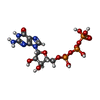 ChemComp-GTP:  ChemComp-MG: 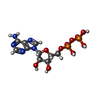 ChemComp-ADP: |
| Source |
|
 Keywords Keywords | CYTOSOLIC PROTEIN / cytoplasmic lattice / maternal effect protein / proteostasis / protein storage |


 mus musculus (house mouse)