 Movie
Movie Controller
 Structure viewers
 About Yorodumi Papers


+Search query
-Structure paper
| Title | Structural and functional insights into the adenosine deaminase of the type III-B CRISPR-Cas system. |
|---|---|
| Journal, issue, pages | Nucleic Acids Res, Vol. 54, Issue 5, Year 2026 |
| Publish date | Feb 24, 2026 |
 Authors Authors | Zhaoxing Li / Jianping Kong / Wanqian Wu / Yan Duan / Ziyi Zhu / Chenyang Hua / Purui Yan / Chen Cao / Xu Cao / Yibei Xiao / Meiling Lu / Meirong Chen /  |
| PubMed Abstract | Type III CRISPR-Cas (Clustered Regularly Interspaced Short Palindromic Repeats and CRISPR-associated proteins) systems confer antiviral immunity via cyclic oligoadenylate (cOA) signaling. Here, we ...Type III CRISPR-Cas (Clustered Regularly Interspaced Short Palindromic Repeats and CRISPR-associated proteins) systems confer antiviral immunity via cyclic oligoadenylate (cOA) signaling. Here, we elucidate a cooperative bacterial defense strategy involving two cOA-activated CRISPR-associated Rossmann fold (CARF)-containing effectors, adenosine deaminase CAAD and ribonuclease Csx1, in Thermoanaerobaculum aquaticum. Genomic analyses indicate widespread co-occurrence of CRISPR-associated adenosine deaminase (CAAD) with ancillary CARF-containing effectors in type III CRISPR systems, suggesting that multiple CARF-containing proteins may contribute to a coordinated cOA-dependent defense. Biochemical and structural studies reveal the intrinsic dynamics of CAAD hexamer, and demonstrate that cA4/cA6 binding stabilizes CAAD hexamers, triggering metal-ion-dependent conversion of ATP into inosine triphosphate. Concurrently, the downstream Csx1 is exclusively activated by cA4 to cleave single-stranded RNA. Strikingly, we found that both effectors are capable of degrading cA4, suggesting that this CAAD-Csx1 pair may be cross-regulated and achieve immunity through a dual-targeting mechanism: in response to infection, Csx1 degrades viral RNA while CAAD disrupts nucleotide metabolism via ATP deamination, which can be relieved via cA4 degradation when infection has been eliminated. This study proposes an enhanced defense mechanism through coordinated activation and regulation of multiple CRISPR effectors by a single signaling molecule, unveiling unprecedented complexity in CRISPR immunoregulation. |
 External links External links | Nucleic Acids Res / PubMed:41841492 / PubMed Central |
| Methods | EM (single particle) |
| Resolution | 2.74 - 3.29 Å |
| Structure data | EMDB-65528: Composite map of the type III CRISPR-associated deaminase in complex cA6 and ATP, State 1  EMDB-65529: Consensus map of the type III CRISPR-associated deaminase in complex cA6 and ATP, State 1  EMDB-65530: Focused map of area 1 of the type III CRISPR-associated deaminase in complex cA6 and ATP, State 1  EMDB-65531: Focused map of area 2 of the type III CRISPR-associated deaminase in complex cA6 and ATP, State 1 EMDB-65532: Composite map of the type III CRISPR-associated deaminase in complex cA6 and ATP, State 2  EMDB-65533: Consensus map of the type III CRISPR-associated deaminase in complex cA6 and ATP, State 2  EMDB-65534: Focused map of area 1 of the type III CRISPR-associated deaminase in complex cA6 and ATP, State 2  EMDB-65535: Focused map of area 2 of the type III CRISPR-associated deaminase in complex cA6 and ATP, State 2 EMDB-65536: Composite map of the type III CRISPR-associated deaminase in complex cA6 and ATP, State 3  EMDB-65537: Consensus map of the type III CRISPR-associated deaminase in complex cA6 and ATP, State 3  EMDB-65538: Focused map of area 1 of the type III CRISPR-associated deaminase in complex cA6 and ATP, State 3  EMDB-65539: Focused map of area 2 of the type III CRISPR-associated deaminase in complex cA6 and ATP, State 3 EMDB-65540: Composite map of the type III CRISPR-associated deaminase in complex cA6 and ATP, State 4  EMDB-65541: Consensus map of the type III CRISPR-associated deaminase in complex cA6 and ATP, State 4  EMDB-65542: Focused map of area 1 of the type III CRISPR-associated deaminase in complex cA6 and ATP, State 4  EMDB-65543: Focused map of area 2 of the type III CRISPR-associated deaminase in complex cA6 and ATP, State 4 EMDB-65544: Composite map of the type III CRISPR-associated deaminase in complex cA6 and ATP, State 5  EMDB-65545: Consensus map of the type III CRISPR-associated deaminase in complex cA6 and ATP, State 5  EMDB-65546: Focused map of area 1 of the type III CRISPR-associated deaminase in complex cA6 and ATP, State 5  EMDB-65547: Focused map of area 2 of the type III CRISPR-associated deaminase in complex cA6 and ATP, State 5  EMDB-65548: Focused map of area 3 of the type III CRISPR-associated deaminase in complex cA6 and ATP, State 5 |
| Chemicals | 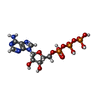 ChemComp-ATP:  ChemComp-ZN:  ChemComp-MG: |
| Source |
|
 Keywords Keywords | HYDROLASE/RNA / deaminase / complex / ATP / HYDROLASE-RNA complex |


 thermoanaerobaculum aquaticum (bacteria)