[English] 日本語
Yorodumi Papers
- Database of articles cited by EMDB/PDB/SASBDB data -

+
Search query

Keywords
Structure methods
Author
Journal
IF

-
Structure paper

TitleMolecular insights into fungal inositol phosphorylceramide synthesis and its inhibition by antifungal aureobasidin A.
Journal, issue, pagesNat Commun, Year 2026
Publish dateFeb 19, 2026
AuthorsJiehui Chen / Yan Ke / Min Zhang / Xinyuan Lin / Zhengkang Hua / Di Zhang / Xinlin Hu / Xuyang Ding / Jiameng Li / Ping Yang / Hongjun Yu /
PubMed AbstractFungal inositol phosphorylceramide (IPC) synthase is an essential enzyme complex that catalyzes a critical step in sphingolipid biosynthesis. It is the molecular target of potent antifungal ...Fungal inositol phosphorylceramide (IPC) synthase is an essential enzyme complex that catalyzes a critical step in sphingolipid biosynthesis. It is the molecular target of potent antifungal aureobasidin A (AbA). Despite its therapeutic relevance, the lack of structural and mechanistic insights into IPC synthase function and inhibition has impeded rational antifungal drug development. Here, we present cryo-EM structures of Saccharomyces cerevisiae IPC synthase in two distinct functional states: a ceramide-bound form and an AbA-inhibited complex. Our study reveals a conserved heterodimeric architecture formed by Aur1 and Kei1, stabilized through extensive protein-protein and lipid-mediated interactions. Within catalytic Aur1, we identify a membrane-embedded reaction chamber harboring a conserved H-H-D catalytic triad (H255, H294, and D298) essential for IPC synthesis. Structural comparisons illuminate the mechanism of ceramide recognition and reveal how AbA acts as a competitive inhibitor by occupying the substrate-binding pocket. Further analyses identify key residues involved in AbA binding and explain the molecular basis of drug resistance. Together, these findings advance the mechanistic understanding of fungal IPC biosynthesis and inhibition, and establish a foundation for developing new antifungal drugs targeting IPC synthase.
External linksNat Commun / PubMed:41708645
MethodsEM (single particle)
Resolution3.5 - 3.53 Å
Structure data

EMDB-65103, PDB-9vj4:
Structure of a membrane-bound inositol phosphorylceramide synthase and ceramide complex
Method: EM (single particle) / Resolution: 3.5 Å

EMDB-66750, PDB-9xd0:
Structure of a membrane-bound inositol phosphorylceramide synthase and Aureobasidin A complex
Method: EM (single particle) / Resolution: 3.53 Å

Chemicals


ChemComp, No image

ChemComp-UJO:
Unknown entry

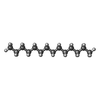
ChemComp-C14:
TETRADECANE

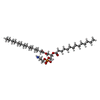
ChemComp-46E:
(2R)-3-{[(S)-(2-aminoethoxy)(hydroxy)phosphoryl]oxy}-2-(tetradecanoyloxy)propyl tetradecanoate

Source
  • Saccharomyces cerevisiae (brewer's yeast)

  • saccharomyces cerevisiae s288c (yeast)
  • synthetic construct (others)
KeywordsLIPID BINDING PROTEIN / membrane protein / inositol phosphorylceramide synthase / TRANSFERASE

+
About Yorodumi Papers

-
News

-
Feb 9, 2022. New format data for meta-information of EMDB entries

New format data for meta-information of EMDB entries

  • Version 3 of the EMDB header file is now the official format.
  • The previous official version 1.9 will be removed from the archive.

Related info.:EMDB header

External links:wwPDB to switch to version 3 of the EMDB data model

-
Aug 12, 2020. Covid-19 info

Covid-19 info

URL: https://pdbj.org/emnavi/covid19.php

New page: Covid-19 featured information page in EM Navigator.

Related info.:Covid-19 info / Mar 5, 2020. Novel coronavirus structure data

+
Mar 5, 2020. Novel coronavirus structure data

Novel coronavirus structure data

Related info.:Yorodumi Speices / Aug 12, 2020. Covid-19 info

External links:COVID-19 featured content - PDBj / Molecule of the Month (242):Coronavirus Proteases

+
Jan 31, 2019. EMDB accession codes are about to change! (news from PDBe EMDB page)

EMDB accession codes are about to change! (news from PDBe EMDB page)

  • The allocation of 4 digits for EMDB accession codes will soon come to an end. Whilst these codes will remain in use, new EMDB accession codes will include an additional digit and will expand incrementally as the available range of codes is exhausted. The current 4-digit format prefixed with “EMD-” (i.e. EMD-XXXX) will advance to a 5-digit format (i.e. EMD-XXXXX), and so on. It is currently estimated that the 4-digit codes will be depleted around Spring 2019, at which point the 5-digit format will come into force.
  • The EM Navigator/Yorodumi systems omit the EMD- prefix.

Related info.:Q: What is EMD? / ID/Accession-code notation in Yorodumi/EM Navigator

External links:EMDB Accession Codes are Changing Soon! / Contact to PDBj

+
Jul 12, 2017. Major update of PDB

Major update of PDB

  • wwPDB released updated PDB data conforming to the new PDBx/mmCIF dictionary.
  • This is a major update changing the version number from 4 to 5, and with Remediation, in which all the entries are updated.
  • In this update, many items about electron microscopy experimental information are reorganized (e.g. em_software).
  • Now, EM Navigator and Yorodumi are based on the updated data.

External links:wwPDB Remediation / Enriched Model Files Conforming to OneDep Data Standards Now Available in the PDB FTP Archive

-
Yorodumi Papers

Database of articles cited by EMDB/PDB/SASBDB data

  • Database of articles cited by EMDB, PDB, and SASBDB entries
  • Using PubMed data

Related info.:EMDB / PDB / SASBDB / Yorodumi / EMN Papers / Changes in new EM Navigator and Yorodumi

Read more