[English] 日本語
Yorodumi Papers
- Database of articles cited by EMDB/PDB/SASBDB data -

+
Search query

Keywords
Structure methods
Author
Journal
IF

-
Structure paper

TitleStructural Basis of Substrate Recognition and Nucleotide Specificity in the Class III-b LanKC Enzyme SalKC.
Journal, issue, pagesACS Chem Biol, Vol. 20, Issue 9, Page 2255-2265, Year 2025
Publish dateSep 19, 2025
AuthorsYifan Li / Kai Shao / Yicong Li / Bee Koon Gan / Min Luo /
PubMed AbstractLanthipeptides are ribosomally synthesized and post-translationally modified peptides (RiPPs) with potent antimicrobial functions. Their biosynthesis is carried out by dedicated biosynthetic enzymes, ...Lanthipeptides are ribosomally synthesized and post-translationally modified peptides (RiPPs) with potent antimicrobial functions. Their biosynthesis is carried out by dedicated biosynthetic enzymes, including the recently described Class III-b LanKC enzymes, which represent a newly defined subclass of trifunctional synthetases. Here, we report the high-resolution cryo-EM structure and biochemical characterization of SalKC from , which catalyzes the maturation of the antimicrobial peptide salivaricin. SalKC adopts a conserved dimeric architecture stabilized by a His36 hotspot, mirroring that of the previously characterized PneKC. Cryo-EM structure resolved to sub-3.0 Å revealed the side chains of the bound leader peptide in atomic detail, allowing clear visualization of a conserved recognition motif and offering new structural insight into peptide engagement. Biochemical assays showed that SalKC prefers ATP over GTP, contrasting with the GTP-preferring PneKC. Structural comparison identified a single amino acid switch: Lys303 in SalKC versus His300 in PneKC, as the key determinant of this specificity. Mutation of Lys303 to histidine reverses nucleotide preference, confirming its functional role. Together, these findings revealed conserved principles and specialized adaptations within Class III-b LanKC enzymes and provided a molecular framework for understanding their substrate and cofactor selectivity.
External linksACS Chem Biol / PubMed:40882187
MethodsEM (single particle)
Resolution2.96 Å
Structure data

EMDB-64143, PDB-9ugq:
Cryo-EM structure of ClassIII Salivaricin modification enzyme SalKC in the presence of SalA
Method: EM (single particle) / Resolution: 2.96 Å

Chemicals

ChemComp-AGS:
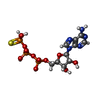
PHOSPHOTHIOPHOSPHORIC ACID-ADENYLATE ESTER / ATP-gamma-S, energy-carrying molecule analogue*YM

ChemComp-MG:
Unknown entry

Source
  • streptococcus salivarius (bacteria)
KeywordsANTIMICROBIAL PROTEIN / Lanthibiotic / RiPPs / LanKC / CryoEM / Antimicrobial peptides

+
About Yorodumi Papers

-
News

-
Feb 9, 2022. New format data for meta-information of EMDB entries

New format data for meta-information of EMDB entries

  • Version 3 of the EMDB header file is now the official format.
  • The previous official version 1.9 will be removed from the archive.

Related info.:EMDB header

External links:wwPDB to switch to version 3 of the EMDB data model

-
Aug 12, 2020. Covid-19 info

Covid-19 info

URL: https://pdbj.org/emnavi/covid19.php

New page: Covid-19 featured information page in EM Navigator.

Related info.:Covid-19 info / Mar 5, 2020. Novel coronavirus structure data

+
Mar 5, 2020. Novel coronavirus structure data

Novel coronavirus structure data

Related info.:Yorodumi Speices / Aug 12, 2020. Covid-19 info

External links:COVID-19 featured content - PDBj / Molecule of the Month (242):Coronavirus Proteases

+
Jan 31, 2019. EMDB accession codes are about to change! (news from PDBe EMDB page)

EMDB accession codes are about to change! (news from PDBe EMDB page)

  • The allocation of 4 digits for EMDB accession codes will soon come to an end. Whilst these codes will remain in use, new EMDB accession codes will include an additional digit and will expand incrementally as the available range of codes is exhausted. The current 4-digit format prefixed with “EMD-” (i.e. EMD-XXXX) will advance to a 5-digit format (i.e. EMD-XXXXX), and so on. It is currently estimated that the 4-digit codes will be depleted around Spring 2019, at which point the 5-digit format will come into force.
  • The EM Navigator/Yorodumi systems omit the EMD- prefix.

Related info.:Q: What is EMD? / ID/Accession-code notation in Yorodumi/EM Navigator

External links:EMDB Accession Codes are Changing Soon! / Contact to PDBj

+
Jul 12, 2017. Major update of PDB

Major update of PDB

  • wwPDB released updated PDB data conforming to the new PDBx/mmCIF dictionary.
  • This is a major update changing the version number from 4 to 5, and with Remediation, in which all the entries are updated.
  • In this update, many items about electron microscopy experimental information are reorganized (e.g. em_software).
  • Now, EM Navigator and Yorodumi are based on the updated data.

External links:wwPDB Remediation / Enriched Model Files Conforming to OneDep Data Standards Now Available in the PDB FTP Archive

-
Yorodumi Papers

Database of articles cited by EMDB/PDB/SASBDB data

  • Database of articles cited by EMDB, PDB, and SASBDB entries
  • Using PubMed data

Related info.:EMDB / PDB / SASBDB / Yorodumi / EMN Papers / Changes in new EM Navigator and Yorodumi

Read more