 Movie
Movie Controller
 Structure viewers
 About Yorodumi Papers


+Search query
-Structure paper
| Title | Cryo-EM structure of the human Derlin-1/p97 complex reveals a hexameric channel in ERAD. |
|---|---|
| Journal, issue, pages | Commun Biol, Vol. 8, Issue 1, Page 1481, Year 2025 |
| Publish date | Oct 17, 2025 |
 Authors Authors | Qian Wang / Deqiang Yao / Bing Rao / Ying Xia / Wenguo Li / Shaobai Li / Mi Cao / Yafeng Shen / An Qin / Yu Cao /   |
| PubMed Abstract | The ER-associated degradation (ERAD) pathway retrotranslocates misfolded proteins from the ER lumen to the cytoplasm for proteasomal degradation. Derlin-1 and p97 are central to this process, forming ...The ER-associated degradation (ERAD) pathway retrotranslocates misfolded proteins from the ER lumen to the cytoplasm for proteasomal degradation. Derlin-1 and p97 are central to this process, forming a canonical 4:6 complex with tetrameric Derlin-1. Using cryo-electron microscopy, we identify a novel human Derlin-1/p97 complex with a 6:6 stoichiometry, where hexameric Derlin-1 assembles as three dimers. This hexameric channel forms a significantly larger trans-ER membrane tunnel, potentially accommodating bulkier substrates. Structural comparisons revealed conformational flexibility in Derlin-1, suggesting the "U"-shaped tetramer may act as an intermediate in hexamer formation. The formation of this hexameric channel is mediated by interactions with p97 and appears dependent on p97's ATPase activity, which provides the driving force for the transition between the tetrameric channel conformation to the intermediate "U"-shaped conformation. These findings highlight the dynamic nature of the Derlin-1/p97 complex and its implications for understanding ERAD retrotranslocation. |
 External links External links | Commun Biol / PubMed:41107410 / PubMed Central |
| Methods | EM (single particle) |
| Resolution | 3.55 Å |
| Structure data | EMDB-63205, PDB-9llk: |
| Chemicals | 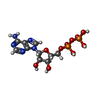 ChemComp-ADP: |
| Source |
|
 Keywords Keywords | MEMBRANE PROTEIN / ERAD |


 homo sapiens (human)