[English] 日本語
Yorodumi Papers
- Database of articles cited by EMDB/PDB/SASBDB data -

+
Search query

Keywords
Structure methods
Author
Journal
IF

-
Structure paper

TitleStructure and mechanism of the human bile acid transporter OSTα-OSTβ.
Journal, issue, pagesNature, Vol. 651, Issue 8104, Page 251-259, Year 2026
Publish dateJan 28, 2026
AuthorsKe Wang / Junping Fan / Huiwen Chen / Bo Huang / Cheng Chi / Rui Yan / Di Wu / Feng Zhou / Wenhua Zhang / Juquan Jiang / Xiaoguang Lei / Daohua Jiang /
PubMed AbstractBile acids (BAs) are crucial amphipathic surfactants that function as multifaceted regulators in various physiological processes, including nutrient absorption and distribution, lipid metabolism and ...Bile acids (BAs) are crucial amphipathic surfactants that function as multifaceted regulators in various physiological processes, including nutrient absorption and distribution, lipid metabolism and inflammation. The human organic solute transporter αβ (OSTα-OSTβ; hereafter referred to as OSTα/β) is a BA transporter that has a key role in the secretion and distribution of BAs. Pathogenic mutations in OSTα/β have been associated with cholestasis. Despite the functional importance of OSTα/β in BA homeostasis, the stoichiometry and assembly of the complex and the molecular mechanism that underlies BA transport by OSTα/β remain unknown. Here we present cryo-electron microscopy structures of human OSTα/β in complex with cholesterols and an endogenous substrate, elucidating the structural basis for the function of OSTα/β. OSTα/β is assembled in a novel dimer-of-heterodimers manner: two OSTα units form the homodimeric core, with two OSTβ units bound to the periphery. OSTα adopts the G-protein-coupled-receptor (GPCR) fold and contains a unique cysteine-rich loop with seven palmitoylation sites; these cooperate with transmembrane helices 5 and 6, constituting a BA recognition site. A positive cavity in OSTα connects the BA site and facilitates the transmembrane translocation of BAs through OSTα/β. Together, this study reveals the architecture and transport mechanism of OSTα/β and provides insights into the structure-function relationships of this crucial transporter in BA homeostasis.
External linksNature / PubMed:41606314
MethodsEM (single particle)
Resolution2.64 - 2.73 Å
Structure data

EMDB-63148, PDB-9ljg:
Cryo-EM structure of human organic solute transporter OSTalpha/beta in apo state
Method: EM (single particle) / Resolution: 2.64 Å

EMDB-63149, PDB-9ljh:
Cryo-EM structure of human organic solute transporter OSTalpha/beta in complex with DHEAS
Method: EM (single particle) / Resolution: 2.73 Å

Chemicals

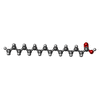
ChemComp-PLM:
PALMITIC ACID

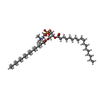
ChemComp-LBN:
1-palmitoyl-2-oleoyl-sn-glycero-3-phosphocholine / phospholipid*YM

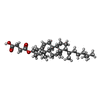
ChemComp-Y01:
CHOLESTEROL HEMISUCCINATE

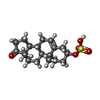
ChemComp-ZWY:
17-oxoandrost-5-en-3beta-yl hydrogen sulfate

Source
  • homo sapiens (human)
KeywordsTRANSPORT PROTEIN / transport / transport AD

+
About Yorodumi Papers

-
News

-
Feb 9, 2022. New format data for meta-information of EMDB entries

New format data for meta-information of EMDB entries

  • Version 3 of the EMDB header file is now the official format.
  • The previous official version 1.9 will be removed from the archive.

Related info.:EMDB header

External links:wwPDB to switch to version 3 of the EMDB data model

-
Aug 12, 2020. Covid-19 info

Covid-19 info

URL: https://pdbj.org/emnavi/covid19.php

New page: Covid-19 featured information page in EM Navigator.

Related info.:Covid-19 info / Mar 5, 2020. Novel coronavirus structure data

+
Mar 5, 2020. Novel coronavirus structure data

Novel coronavirus structure data

Related info.:Yorodumi Speices / Aug 12, 2020. Covid-19 info

External links:COVID-19 featured content - PDBj / Molecule of the Month (242):Coronavirus Proteases

+
Jan 31, 2019. EMDB accession codes are about to change! (news from PDBe EMDB page)

EMDB accession codes are about to change! (news from PDBe EMDB page)

  • The allocation of 4 digits for EMDB accession codes will soon come to an end. Whilst these codes will remain in use, new EMDB accession codes will include an additional digit and will expand incrementally as the available range of codes is exhausted. The current 4-digit format prefixed with “EMD-” (i.e. EMD-XXXX) will advance to a 5-digit format (i.e. EMD-XXXXX), and so on. It is currently estimated that the 4-digit codes will be depleted around Spring 2019, at which point the 5-digit format will come into force.
  • The EM Navigator/Yorodumi systems omit the EMD- prefix.

Related info.:Q: What is EMD? / ID/Accession-code notation in Yorodumi/EM Navigator

External links:EMDB Accession Codes are Changing Soon! / Contact to PDBj

+
Jul 12, 2017. Major update of PDB

Major update of PDB

  • wwPDB released updated PDB data conforming to the new PDBx/mmCIF dictionary.
  • This is a major update changing the version number from 4 to 5, and with Remediation, in which all the entries are updated.
  • In this update, many items about electron microscopy experimental information are reorganized (e.g. em_software).
  • Now, EM Navigator and Yorodumi are based on the updated data.

External links:wwPDB Remediation / Enriched Model Files Conforming to OneDep Data Standards Now Available in the PDB FTP Archive

-
Yorodumi Papers

Database of articles cited by EMDB/PDB/SASBDB data

  • Database of articles cited by EMDB, PDB, and SASBDB entries
  • Using PubMed data

Related info.:EMDB / PDB / SASBDB / Yorodumi / EMN Papers / Changes in new EM Navigator and Yorodumi

Read more