[English] 日本語
Yorodumi Papers
- Database of articles cited by EMDB/PDB/SASBDB data -

+
Search query

Keywords
Structure methods
Author
Journal
IF

-
Structure paper

TitleStructures of PSI-FCPI from Thalassiosira pseudonana grown under high light provide evidence for convergent evolution and light-adaptive strategies in diatom FCPIs.
Journal, issue, pagesJ Integr Plant Biol, Vol. 67, Issue 4, Page 949-966, Year 2025
Publish dateDec 13, 2024
AuthorsYue Feng / Zhenhua Li / Yang Yang / Lili Shen / Xiaoyi Li / Xueyang Liu / Xiaofei Zhang / Jinyang Zhang / Fei Ren / Yuan Wang / Cheng Liu / Guangye Han / Xuchu Wang / Tingyun Kuang / Jian-Ren Shen / Wenda Wang /
PubMed AbstractDiatoms rely on fucoxanthin chlorophyll a/c-binding proteins (FCPs) for light harvesting and energy quenching under marine environments. Here we report two cryo-electron microscopic structures of ...Diatoms rely on fucoxanthin chlorophyll a/c-binding proteins (FCPs) for light harvesting and energy quenching under marine environments. Here we report two cryo-electron microscopic structures of photosystem I (PSI) with either 13 or five fucoxanthin chlorophyll a/c-binding protein Is (FCPIs) at 2.78 and 3.20 Å resolutions from Thalassiosira pseudonana grown under high light (HL) conditions. Among them, five FCPIs are stably associated with the PSI core, these include Lhcr3, RedCAP, Lhcq8, Lhcf10, and FCP3. The eight additional Lhcr-type FCPIs are loosely associated with the PSI core and detached under the present purification conditions. The pigments of this centric diatom showed a higher proportion of chlorophylls a, diadinoxanthins, and diatoxanthins; some of the chlorophyll as and diadinoxanthins occupy the locations of fucoxanthins found in the huge PSI-FCPI from another centric diatom Chaetoceros gracilis grown under low-light conditions. These additional chlorophyll as may form more energy transfer pathways and additional diadinoxanthins may form more energy dissipation sites relying on the diadinoxanthin-diatoxanthin cycle. These results reveal the assembly mechanism of FCPIs and corresponding light-adaptive strategies of T. pseudonana PSI-FCPI, as well as the convergent evolution of the diatom PSI-FCPI structures.
External linksJ Integr Plant Biol / PubMed:39670505
MethodsEM (single particle)
Resolution2.78 - 3.2 Å
Structure data

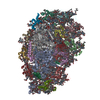
EMDB-60032, PDB-8zeh:
PSI-FCPI-L in Thalassiosira pseudonana
Method: EM (single particle) / Resolution: 2.78 Å

EMDB-60044, PDB-8zet:
Tp-PSI-FCPI-S in Thalassiosira pseudonana
Method: EM (single particle) / Resolution: 3.2 Å

Chemicals

ChemComp-DD6:
(3S,3'R,5R,6S,7cis)-7',8'-didehydro-5,6-dihydro-5,6-epoxy-beta,beta-carotene-3,3'-diol

ChemComp-CLA:
CHLOROPHYLL A

ChemComp-KC1:
Chlorophyll c1

ChemComp-LMG:
1,2-DISTEAROYL-MONOGALACTOSYL-DIGLYCERIDE

ChemComp-A86:
(3S,3'S,5R,5'R,6S,6'R,8'R)-3,5'-dihydroxy-8-oxo-6',7'-didehydro-5,5',6,6',7,8-hexahydro-5,6-epoxy-beta,beta-caroten-3'-

ChemComp-LHG:
1,2-DIPALMITOYL-PHOSPHATIDYL-GLYCEROLE / phospholipid*YM

ChemComp-BCR:
BETA-CAROTENE

ChemComp-SQD:
1,2-DI-O-ACYL-3-O-[6-DEOXY-6-SULFO-ALPHA-D-GLUCOPYRANOSYL]-SN-GLYCEROL

ChemComp-PQN:
PHYLLOQUINONE

ChemComp-ET4:
(1~{R})-3,5,5-trimethyl-4-[(1~{E},3~{E},5~{E},7~{E},9~{E},11~{E},13~{E},15~{E})-3,7,12,16-tetramethyl-18-[(4~{R})-2,6,6-trimethyl-4-oxidanyl-cyclohexen-1-yl]octadeca-1,3,5,7,9,11,13,15-octaen-17-ynyl]cyclohex-3-en-1-ol

ChemComp-SF4:
IRON/SULFUR CLUSTER

ChemComp-DGD:
DIGALACTOSYL DIACYL GLYCEROL (DGDG)

Source
  • thalassiosira pseudonana ccmp1335 (Diatom)

KeywordsPHOTOSYNTHESIS / photosystem I / Tp-PSI-FCPI-S in Thalassiosira pseudonana

+
About Yorodumi Papers

-
News

-
Feb 9, 2022. New format data for meta-information of EMDB entries

New format data for meta-information of EMDB entries

  • Version 3 of the EMDB header file is now the official format.
  • The previous official version 1.9 will be removed from the archive.

Related info.:EMDB header

External links:wwPDB to switch to version 3 of the EMDB data model

-
Aug 12, 2020. Covid-19 info

Covid-19 info

URL: https://pdbj.org/emnavi/covid19.php

New page: Covid-19 featured information page in EM Navigator.

Related info.:Covid-19 info / Mar 5, 2020. Novel coronavirus structure data

+
Mar 5, 2020. Novel coronavirus structure data

Novel coronavirus structure data

Related info.:Yorodumi Speices / Aug 12, 2020. Covid-19 info

External links:COVID-19 featured content - PDBj / Molecule of the Month (242):Coronavirus Proteases

+
Jan 31, 2019. EMDB accession codes are about to change! (news from PDBe EMDB page)

EMDB accession codes are about to change! (news from PDBe EMDB page)

  • The allocation of 4 digits for EMDB accession codes will soon come to an end. Whilst these codes will remain in use, new EMDB accession codes will include an additional digit and will expand incrementally as the available range of codes is exhausted. The current 4-digit format prefixed with “EMD-” (i.e. EMD-XXXX) will advance to a 5-digit format (i.e. EMD-XXXXX), and so on. It is currently estimated that the 4-digit codes will be depleted around Spring 2019, at which point the 5-digit format will come into force.
  • The EM Navigator/Yorodumi systems omit the EMD- prefix.

Related info.:Q: What is EMD? / ID/Accession-code notation in Yorodumi/EM Navigator

External links:EMDB Accession Codes are Changing Soon! / Contact to PDBj

+
Jul 12, 2017. Major update of PDB

Major update of PDB

  • wwPDB released updated PDB data conforming to the new PDBx/mmCIF dictionary.
  • This is a major update changing the version number from 4 to 5, and with Remediation, in which all the entries are updated.
  • In this update, many items about electron microscopy experimental information are reorganized (e.g. em_software).
  • Now, EM Navigator and Yorodumi are based on the updated data.

External links:wwPDB Remediation / Enriched Model Files Conforming to OneDep Data Standards Now Available in the PDB FTP Archive

-
Yorodumi Papers

Database of articles cited by EMDB/PDB/SASBDB data

  • Database of articles cited by EMDB, PDB, and SASBDB entries
  • Using PubMed data

Related info.:EMDB / PDB / SASBDB / Yorodumi / EMN Papers / Changes in new EM Navigator and Yorodumi

Read more