[English] 日本語
Yorodumi Papers
- Database of articles cited by EMDB/PDB/SASBDB data -

+
Search query

Keywords
Structure methods
Author
Journal
IF

-
Structure paper

TitleMX2 Mediates Collapse of the HIV-1 Capsid.
Journal, issue, pagesbioRxiv, Year 2026
Publish dateMay 8, 2026
AuthorsAndrew Goodale / Szu-Wei Huang / Nathalia Almeida / Dave J Williamson / Nikoloz Shkriabai / Gilberto Betancor / Luis Apolonia / Frank DiMaio / Sergi Padilla-Parra / Mamuka Kvaratskhelia / Julien R C Bergeron / Michael H Malim /
PubMed AbstractThe HIV-1 capsid core encapsulates the viral genome and mediates its delivery into the host cell's nucleus. It is composed of multiple copies of the Capsid (CA, p24) protein, assembled into hexamers ...The HIV-1 capsid core encapsulates the viral genome and mediates its delivery into the host cell's nucleus. It is composed of multiple copies of the Capsid (CA, p24) protein, assembled into hexamers and pentamers to create a lattice that forms a fullerene-like cone. Myxovirus resistance 2 (MX2) is an HIV-1 restriction factor that binds to the capsid core and blocks nuclear import of the viral genome. Here, we define a minimal region of MX2 required for HIV-1 restriction and produce a corresponding functional recombinant protein. We have used cryo-electron microscopy to determine the structure of this MX2 fragment bound to the tri-hexamer interface of the capsid lattice, revealing a large, buried interface combining electrostatic and hydrophobic interactions. This structure, together with assays that measure capsid core destabilisation, shows that MX2 binding induces conformational rearrangements in the capsid lattice that culminate in a loss of integrity. These results support a model whereby MX2 exerts its antiviral activity by disrupting the capsid lattice, inducing premature fragmentation and preventing HIV-1 nuclear import. By revealing the structural basis for MX2-mediated restriction, this work also provides the framework for the development of anti-HIV molecules that mimic MX2 restriction.
External linksbioRxiv / PubMed:42146390 / PubMed Central
MethodsEM (single particle)
Resolution3.47 - 4.64 Å
Structure data

EMDB-57888, PDB-30od:
HIV-1 CA hexamer (MX2 bound)
Method: EM (single particle) / Resolution: 3.75 Å

EMDB-57889, PDB-30oe:
Unbound HIV-1 CA hexamer
Method: EM (single particle) / Resolution: 3.47 Å

EMDB-57890, PDB-30of:
HIV-1 capsid tri-hexamer bound to MX2
Method: EM (single particle) / Resolution: 4.64 Å

EMDB-57891, PDB-30og:
HIV-1 CA tri-hexamer interface
Method: EM (single particle) / Resolution: 4.1 Å

Chemicals

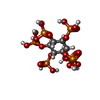
ChemComp-IHP:
INOSITOL HEXAKISPHOSPHATE

Source
  • hiv-1 group m (virus)
  • synthetic construct (others)
  • homo sapiens (human)
KeywordsVIRAL PROTEIN / HIV-1 CA / ANTIMICROBIAL PROTEIN / HIV-1 / Capsid / MX2 / ANTIVIRAL PROTEIN

+
About Yorodumi Papers

-
News

-
Feb 9, 2022. New format data for meta-information of EMDB entries

New format data for meta-information of EMDB entries

  • Version 3 of the EMDB header file is now the official format.
  • The previous official version 1.9 will be removed from the archive.

Related info.:EMDB header

External links:wwPDB to switch to version 3 of the EMDB data model

-
Aug 12, 2020. Covid-19 info

Covid-19 info

URL: https://pdbj.org/emnavi/covid19.php

New page: Covid-19 featured information page in EM Navigator.

Related info.:Covid-19 info / Mar 5, 2020. Novel coronavirus structure data

+
Mar 5, 2020. Novel coronavirus structure data

Novel coronavirus structure data

Related info.:Yorodumi Speices / Aug 12, 2020. Covid-19 info

External links:COVID-19 featured content - PDBj / Molecule of the Month (242):Coronavirus Proteases

+
Jan 31, 2019. EMDB accession codes are about to change! (news from PDBe EMDB page)

EMDB accession codes are about to change! (news from PDBe EMDB page)

  • The allocation of 4 digits for EMDB accession codes will soon come to an end. Whilst these codes will remain in use, new EMDB accession codes will include an additional digit and will expand incrementally as the available range of codes is exhausted. The current 4-digit format prefixed with “EMD-” (i.e. EMD-XXXX) will advance to a 5-digit format (i.e. EMD-XXXXX), and so on. It is currently estimated that the 4-digit codes will be depleted around Spring 2019, at which point the 5-digit format will come into force.
  • The EM Navigator/Yorodumi systems omit the EMD- prefix.

Related info.:Q: What is EMD? / ID/Accession-code notation in Yorodumi/EM Navigator

External links:EMDB Accession Codes are Changing Soon! / Contact to PDBj

+
Jul 12, 2017. Major update of PDB

Major update of PDB

  • wwPDB released updated PDB data conforming to the new PDBx/mmCIF dictionary.
  • This is a major update changing the version number from 4 to 5, and with Remediation, in which all the entries are updated.
  • In this update, many items about electron microscopy experimental information are reorganized (e.g. em_software).
  • Now, EM Navigator and Yorodumi are based on the updated data.

External links:wwPDB Remediation / Enriched Model Files Conforming to OneDep Data Standards Now Available in the PDB FTP Archive

-
Yorodumi Papers

Database of articles cited by EMDB/PDB/SASBDB data

  • Database of articles cited by EMDB, PDB, and SASBDB entries
  • Using PubMed data

Related info.:EMDB / PDB / SASBDB / Yorodumi / EMN Papers / Changes in new EM Navigator and Yorodumi

Read more