 Movie
Movie Controller
 Structure viewers
 About Yorodumi Papers


+Search query
-Structure paper
| Title | DNAAF19-RUVBL1/2 complex recruits multiple adaptors to promote dynein arm assembly. |
|---|---|
| Journal, issue, pages | Proc Natl Acad Sci U S A, Vol. 123, Issue 41, Page e2612755123, Year 2026 |
| Publish date | Oct 13, 2026 |
 Authors Authors | Mafalda de Almeida Gomes / Emma Wood / Thomas Burgoyne / Franziska Klose / Denisa Batrinu / Karsten Boldt / Glenn Carrington / Yehuda Halfon / Rachel George / G Nasir Khan / Tina Beyer / Hannah M Mitchison / Takashi Ochi /   |
| PubMed Abstract | Cilia are microtubule-based organelles essential for sensing, motility, and fluid transport. Motile cilia rely on inner and outer dynein arms, large multiprotein motor complexes, for force generation ...Cilia are microtubule-based organelles essential for sensing, motility, and fluid transport. Motile cilia rely on inner and outer dynein arms, large multiprotein motor complexes, for force generation and the characteristic bending motion required for ciliary beating. Before being incorporated into cilia, these dynein arms are preassembled in the cytoplasm by dynein axonemal assembly factors (DNAAFs). Defects in this assembly pathway often cause the inherited genetic condition primary ciliary dyskinesia (PCD), in which the loss of dynein arms impairs ciliary motility. The molecular mechanisms governing the precise and timely assembly of dynein arms by DNAAFs remain elusive. Here, we investigated the role of dynein axonemal assembly factor 19 (DNAAF19), a DNAAF frequently mutated in PCD patients with combined inner and outer dynein arm defects. Using biochemical, structural, and proteomic approaches, we find that DNAAF19 is a monomeric protein that interacts directly with the heterohexamer of RUVBL1 and RUVBL2, a multifunctional cochaperone complex involved in ciliary dynein arm assembly. The recurrent PCD-causing variant p.His154Pro partially destabilizes the interaction of DNAAF19 with RUVBL1-RUVBL2. Moreover, we identify Deleted in Primary Ciliary Dyskinesia forming a cocomplex with RUVBL1/2-DNAAF19 in vivo and in vitro. This indicates similarity to R2TP, the HSP90 cochaperone composed of RUVBL1/2-RPAP3-PIH1D1 that assembles different molecular machineries in cells, and to the RUVBL1/2-SPAG1-PIH1D2 complex associated with ciliary dynein arm assembly and PCD. Our results suggest that DNAAF19 acts as a DNAAF in concert with RUVBL1/2 and its interacting proteins, providing insights into the molecular coordination of dynein arm assembly and cell biology of PCD. |
 External links External links | Proc Natl Acad Sci U S A / PubMed:42837447 |
| Methods | EM (single particle) |
| Resolution | 3.37 - 3.47 Å |
| Structure data | EMDB-57214, PDB-29jr: EMDB-57241, PDB-29kn: |
| Chemicals | 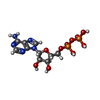 ChemComp-ADP: |
| Source |
|
 Keywords Keywords | CHAPERONE / Motile cilia / Axonemal dynein assembly factors / AAA-ATPases / protein complex assembly / Dynein axonemal assembly factor |


 homo sapiens (human)