[English] 日本語
Yorodumi Papers
- Database of articles cited by EMDB/PDB/SASBDB data -

+
Search query

Keywords
Structure methods
Author
Journal
IF

-
Structure paper

TitleAdaptations in Plasmodium tubulin determine distinct microtubule architectures, mechanics and drug susceptibility.
Journal, issue, pagesNat Commun, Vol. 17, Issue 1, Year 2026
Publish dateMar 5, 2026
AuthorsMamata Bangera / Jiangbo Wu / Daniel Beckett / Dominik Fachet / Josie L Ferreira / Gregory A Voth / Simone Reber / Carolyn A Moores /
PubMed AbstractMicrotubules are ubiquitous yet diverse cytoskeleton filaments. However, tubulin conservation presents challenges in understanding the origins of diverse microtubule architectures. The mechanisms by ...Microtubules are ubiquitous yet diverse cytoskeleton filaments. However, tubulin conservation presents challenges in understanding the origins of diverse microtubule architectures. The mechanisms by which microtubule architecture varies through the life cycle of the malaria-causing parasite Plasmodium are not understood and provide a valuable framework for exploring how intrinsic properties of tubulin contribute to architectural variety. Using parasite-purified tubulin, we determine P. falciparum microtubule structures by cryo-electron microscopy. Parasite-specific sequences change the tubulin dimer structure, suggesting how drug susceptibility and polymer properties are modified. Within the P. falciparum microtubule, lateral contacts are smaller but stronger, and the lattice is stiffer than in brain microtubules. Non-canonical microtubule architectures found in parasites are highly similar to those observed in vitro, validating the physiological relevance of these properties. Our findings show how evolutionary adaptation of tubulin modulates the material properties of the microtubule cytoskeleton.
External linksNat Commun / PubMed:41786731 / PubMed Central
MethodsEM (helical sym.) / EM (subtomogram averaging)
Resolution2.9 - 25.0 Å
Structure data

EMDB-53571, PDB-9r4x:
13 protofilament P. falciparum paclitaxel stabilised GDP microtubule
Method: EM (helical sym.) / Resolution: 3.2 Å

EMDB-53572, PDB-9r4y:
15 protofilament P. falciparum GMPCPP microtubule
Method: EM (helical sym.) / Resolution: 2.9 Å

EMDB-56294: Plasmodium falciparum gametocyte microtubule with 15 protofilaments determined in situ
Method: EM (subtomogram averaging) / Resolution: 25.0 Å

Chemicals

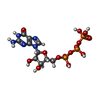
ChemComp-GTP:
GUANOSINE-5'-TRIPHOSPHATE / GTP, energy-carrying molecule*YM

ChemComp-MG:
Unknown entry

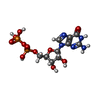
ChemComp-GDP:
GUANOSINE-5'-DIPHOSPHATE / GDP, energy-carrying molecule*YM

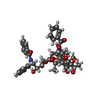
ChemComp-TA1:
TAXOL / medication, chemotherapy*YM

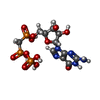
ChemComp-G2P:
PHOSPHOMETHYLPHOSPHONIC ACID GUANYLATE ESTER / GMP-CPP, energy-carrying molecule analogue*YM

Source
  • plasmodium falciparum 3d7 (eukaryote)
KeywordsSTRUCTURAL PROTEIN / Malaria / parasite / cytoskeleton / microtubule / paclitaxel / GMPCPP

+
About Yorodumi Papers

-
News

-
Feb 9, 2022. New format data for meta-information of EMDB entries

New format data for meta-information of EMDB entries

  • Version 3 of the EMDB header file is now the official format.
  • The previous official version 1.9 will be removed from the archive.

Related info.:EMDB header

External links:wwPDB to switch to version 3 of the EMDB data model

-
Aug 12, 2020. Covid-19 info

Covid-19 info

URL: https://pdbj.org/emnavi/covid19.php

New page: Covid-19 featured information page in EM Navigator.

Related info.:Covid-19 info / Mar 5, 2020. Novel coronavirus structure data

+
Mar 5, 2020. Novel coronavirus structure data

Novel coronavirus structure data

Related info.:Yorodumi Speices / Aug 12, 2020. Covid-19 info

External links:COVID-19 featured content - PDBj / Molecule of the Month (242):Coronavirus Proteases

+
Jan 31, 2019. EMDB accession codes are about to change! (news from PDBe EMDB page)

EMDB accession codes are about to change! (news from PDBe EMDB page)

  • The allocation of 4 digits for EMDB accession codes will soon come to an end. Whilst these codes will remain in use, new EMDB accession codes will include an additional digit and will expand incrementally as the available range of codes is exhausted. The current 4-digit format prefixed with “EMD-” (i.e. EMD-XXXX) will advance to a 5-digit format (i.e. EMD-XXXXX), and so on. It is currently estimated that the 4-digit codes will be depleted around Spring 2019, at which point the 5-digit format will come into force.
  • The EM Navigator/Yorodumi systems omit the EMD- prefix.

Related info.:Q: What is EMD? / ID/Accession-code notation in Yorodumi/EM Navigator

External links:EMDB Accession Codes are Changing Soon! / Contact to PDBj

+
Jul 12, 2017. Major update of PDB

Major update of PDB

  • wwPDB released updated PDB data conforming to the new PDBx/mmCIF dictionary.
  • This is a major update changing the version number from 4 to 5, and with Remediation, in which all the entries are updated.
  • In this update, many items about electron microscopy experimental information are reorganized (e.g. em_software).
  • Now, EM Navigator and Yorodumi are based on the updated data.

External links:wwPDB Remediation / Enriched Model Files Conforming to OneDep Data Standards Now Available in the PDB FTP Archive

-
Yorodumi Papers

Database of articles cited by EMDB/PDB/SASBDB data

  • Database of articles cited by EMDB, PDB, and SASBDB entries
  • Using PubMed data

Related info.:EMDB / PDB / SASBDB / Yorodumi / EMN Papers / Changes in new EM Navigator and Yorodumi

Read more