[English] 日本語
Yorodumi Papers
- Database of articles cited by EMDB/PDB/SASBDB data -

+
Search query

Keywords
Structure methods
Author
Journal
IF

-
Structure paper

TitleUncovering the structural impact of KatG Ser315 mutations in Mycobacterium tuberculosis via cryo-EM.
Journal, issue, pagesProtein Sci, Vol. 35, Issue 1, Page e70409, Year 2026
Publish dateDec 23, 2025
AuthorsThomas Allport / Amanda K Chaplin /
PubMed AbstractMycobacterium tuberculosis (Mtb), the causative agent of tuberculosis (TB), is responsible for a global health burden affecting over a quarter of the world's population. The increasing prevalence of ...Mycobacterium tuberculosis (Mtb), the causative agent of tuberculosis (TB), is responsible for a global health burden affecting over a quarter of the world's population. The increasing prevalence of drug-resistant TB poses a significant threat to current treatment strategies. Isoniazid (INH) is a first-line prodrug used in TB therapy, which requires activation by the catalase-peroxidase enzyme KatG. Upon activation, INH inhibits InhA, thereby disrupting mycolic acid biosynthesis, a crucial process for maintaining Mtb's distinctive, lipid-rich cell wall. The most common naturally occurring resistance-associated mutation in KatG is S315T, though other variants at this position, such as S315G, S315N, S315I, and S315R, have also been reported. In this study, we employ cryo-electron microscopy (cryo-EM) to investigate the structural basis of INH resistance conferred by these KatG variants. We present high-resolution cryo-EM structures that reveal heterogeneity in heme loading among the mutants. Detailed structural analysis highlights alterations in the hydrogen-bonding network and substrate access channel unique to each variant, offering direct comparisons with the wild-type (WT) KatG protein. Our findings provide a molecular explanation for clinical INH resistance and lay the groundwork for the rational design of next-generation anti-TB therapeutics.
External linksProtein Sci / PubMed:41432360 / PubMed Central
MethodsEM (single particle)
Resolution2.27 - 3.0 Å
Structure data

EMDB-54872, PDB-9sgl:
S315T KatG mutant two Heme
Method: EM (single particle) / Resolution: 2.27 Å

EMDB-54873, PDB-9sgm:
S315I KatG mutant two Heme
Method: EM (single particle) / Resolution: 2.86 Å

EMDB-54874, PDB-9sgn:
S315I KatG mutant no Heme
Method: EM (single particle) / Resolution: 3.0 Å

EMDB-54875, PDB-9sgo:
S315N KatG mutant one Heme
Method: EM (single particle) / Resolution: 2.74 Å

EMDB-54876, PDB-9sgp:
S315R KatG mutant two Heme
Method: EM (single particle) / Resolution: 2.67 Å

EMDB-54877, PDB-9sgq:
S315R KatG mutant one Heme
Method: EM (single particle) / Resolution: 2.76 Å

EMDB-54878, PDB-9sgr:
S315N KatG mutant no heme
Method: EM (single particle) / Resolution: 2.6 Å

EMDB-54879, PDB-9sgs:
S315G KatG mutant no Heme
Method: EM (single particle) / Resolution: 2.77 Å

EMDB-54880, PDB-9sgt:
S315G KatG mutant one Heme
Method: EM (single particle) / Resolution: 2.84 Å

EMDB-54882, PDB-9sgy:
S315I KatG mutant one heme
Method: EM (single particle) / Resolution: 2.34 Å

Chemicals

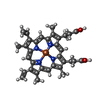
ChemComp-HEM:
PROTOPORPHYRIN IX CONTAINING FE

Source
  • mycobacterium tuberculosis (bacteria)
KeywordsMETAL BINDING PROTEIN / Catalase / Peoxidase / Enzyme / Heme

+
About Yorodumi Papers

-
News

-
Feb 9, 2022. New format data for meta-information of EMDB entries

New format data for meta-information of EMDB entries

  • Version 3 of the EMDB header file is now the official format.
  • The previous official version 1.9 will be removed from the archive.

Related info.:EMDB header

External links:wwPDB to switch to version 3 of the EMDB data model

-
Aug 12, 2020. Covid-19 info

Covid-19 info

URL: https://pdbj.org/emnavi/covid19.php

New page: Covid-19 featured information page in EM Navigator.

Related info.:Covid-19 info / Mar 5, 2020. Novel coronavirus structure data

+
Mar 5, 2020. Novel coronavirus structure data

Novel coronavirus structure data

Related info.:Yorodumi Speices / Aug 12, 2020. Covid-19 info

External links:COVID-19 featured content - PDBj / Molecule of the Month (242):Coronavirus Proteases

+
Jan 31, 2019. EMDB accession codes are about to change! (news from PDBe EMDB page)

EMDB accession codes are about to change! (news from PDBe EMDB page)

  • The allocation of 4 digits for EMDB accession codes will soon come to an end. Whilst these codes will remain in use, new EMDB accession codes will include an additional digit and will expand incrementally as the available range of codes is exhausted. The current 4-digit format prefixed with “EMD-” (i.e. EMD-XXXX) will advance to a 5-digit format (i.e. EMD-XXXXX), and so on. It is currently estimated that the 4-digit codes will be depleted around Spring 2019, at which point the 5-digit format will come into force.
  • The EM Navigator/Yorodumi systems omit the EMD- prefix.

Related info.:Q: What is EMD? / ID/Accession-code notation in Yorodumi/EM Navigator

External links:EMDB Accession Codes are Changing Soon! / Contact to PDBj

+
Jul 12, 2017. Major update of PDB

Major update of PDB

  • wwPDB released updated PDB data conforming to the new PDBx/mmCIF dictionary.
  • This is a major update changing the version number from 4 to 5, and with Remediation, in which all the entries are updated.
  • In this update, many items about electron microscopy experimental information are reorganized (e.g. em_software).
  • Now, EM Navigator and Yorodumi are based on the updated data.

External links:wwPDB Remediation / Enriched Model Files Conforming to OneDep Data Standards Now Available in the PDB FTP Archive

-
Yorodumi Papers

Database of articles cited by EMDB/PDB/SASBDB data

  • Database of articles cited by EMDB, PDB, and SASBDB entries
  • Using PubMed data

Related info.:EMDB / PDB / SASBDB / Yorodumi / EMN Papers / Changes in new EM Navigator and Yorodumi

Read more