 Movie
Movie Controller
 Structure viewers
 About Yorodumi Papers


+Search query
-Structure paper
| Title | Cryo-EM structure of a single-chain β1-adrenoceptor - AmpC β-lactamase fusion protein. |
|---|---|
| Journal, issue, pages | J Struct Biol, Vol. 218, Issue 3, Page 108349, Year 2026 |
| Publish date | Jul 15, 2026 |
 Authors Authors | Gabriella Collu / Inayathulla Mohammed / Aleix Lafita / Tobias Bierig / Emiliya Poghosyan / Spencer Bliven / Julius Rabl / Pavel Afanasyev / Roger M Benoit /  |
| PubMed Abstract | The insertion of fusion proteins has enabled the crystallization of a wide range of G-protein-coupled receptors. Here, we adapted this engineering strategy to cryo-electron microscopy (cryo-EM). We ...The insertion of fusion proteins has enabled the crystallization of a wide range of G-protein-coupled receptors. Here, we adapted this engineering strategy to cryo-electron microscopy (cryo-EM). We inserted the soluble protein AmpC β-lactamase into the third intracellular loop (ICL3) of ultra-thermostable β1-adrenoceptor (β1AR) via chimeric helix fusions. Biochemical and biophysical characterization showed that the resulting fusion protein after expression, solubilization and purification was monodisperse and able to bind the known β1AR weak partial agonist cyanopindolol, and the antagonist propranolol. The protein particles comprised sufficient mass and discernable structural features to elucidate its cryo-EM structure in complex with cyanopindolol without any natural (G-proteins, arrestins) or artificial (Nanobodies, DARPins) binding partners, to an overall resolution of 4.2 Å. The seven-helix architecture and helix eight, as well as both GPCR - AmpC β-lactamase connections are clearly resolved. β1AR is in an inactive-like conformation. 3D variability analysis revealed significant flexibility between the two protein domains and within the GPCR helices. The map contains clear density for the cyanopindolol. The fusion protein geometry is expected to be compatible with a subset of other class A GPCRs exhibiting suitable architecture. For receptors meeting these geometric requirements, this approach may facilitate cryo-EM structure determination of GPCR-ligand complexes in an inactive-like state. In addition, it could support structural studies of GPCRs in the absence of ligands. |
 External links External links | J Struct Biol / PubMed:42456834 |
| Methods | EM (single particle) |
| Resolution | 4.2 Å |
| Structure data | EMDB-54355, PDB-9rx1: |
| Chemicals | 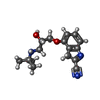 ChemComp-P32: |
| Source |
|
 Keywords Keywords | SIGNALING PROTEIN / G protein-coupled receptor / cyanopindolol / AmpC beta-lactamase / fusion protein / cryo-EM |


 meleagris gallopavo (turkey)
 escherichia coli k-12 (bacteria)