 Movie
Movie Controller
 Structure viewers
 About Yorodumi Papers


+Search query
-Structure paper
| Title | A Tetrapodal Tryptophan Derivative with Multiple Exposed Free Carboxylic Acids Blocks Host Cell Entry of Omicron SARS-Cov-2 and Respiratory Syncytial Virus. |
|---|---|
| Journal, issue, pages | ACS Omega, Vol. 10, Issue 46, Page 56830-56844, Year 2025 |
| Publish date | Nov 25, 2025 |
 Authors Authors | Olaia Martí-Marí / Marta Moreno-Simoni / Ana Isabel Avilés-Alía / Luciana Rusu / Alicia Forcada-Nadal / Anmol Adhav / Maria Luisa López-Redondo / Ana-Belén Blázquez / Ana Esteban / Nereida Jiménez de Oya / Alberto Marina / Vicente Rubio / José Luis Llácer / Federico Gago / Miguel A Martín-Acebes / María-Jesús Pérez-Pérez / Ron Geller / Ana San-Félix /  |
| PubMed Abstract | Omicron sublineages of SARS-CoV-2 have accelerated the spread of the virus and facilitated immune escape. In this work, we demonstrate that compound , a potent HIV and enterovirus A71 (EV-A71) entry ...Omicron sublineages of SARS-CoV-2 have accelerated the spread of the virus and facilitated immune escape. In this work, we demonstrate that compound , a potent HIV and enterovirus A71 (EV-A71) entry inhibitor previously discovered in our research group, also displays potent activity against different SARS-CoV-2 Omicron variants while showing no activity against the ancestral SARS-CoV-2 Wuhan strain. Moreover, its sodium salt () exhibited antiviral activity in a murine model of Omicron BA.1. infection. Indeed, biophysical and cryo-EM studies revealed binding of to the Omicron BA.1 spike (S) protein stabilizing a "closed" form in which ∼75% of the S particles have all RBDs down, unlike the usual "open" form with one RBD up. Such "closed" form decreases S avidity for the cellular receptor ACE2, thus inhibiting viral entry. Computer-assisted modeling studies strongly suggest that can interact with the intersubunit cavity of the S trimer of the Omicron BA.1 subvariant, making use of the multivalency principle. In this context, compound can be considered a pharmacological tool for studying and validating new antiviral strategies against Omicron variants. We also identified as a potent inhibitor of RSV and the Ebola virus. The effectiveness of against a diverse set of viruses of different families supports its use as a promising lead for the development of entry inhibitors against current and future viral infections, representing a meaningful advance in the field. |
 External links External links | ACS Omega / PubMed:41322621 / PubMed Central |
| Methods | EM (single particle) |
| Resolution | 6.25 Å |
| Structure data |  EMDB-54176: CryoEM structure of the spike S protein trimer of the omicron BA.1 variant prepared in the presence of compound II-Na salt |
| Source |
|

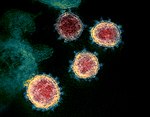 SARS-CoV-2 (virus)