 Movie
Movie Controller
 Structure viewers
 About Yorodumi Papers


+Search query
-Structure paper
| Title | Biochemical and structural characterization of the human gut microbiome metallopeptidase IgAse provides insight into its unique specificity for the Fab' region of IgA1 and IgA2. |
|---|---|
| Journal, issue, pages | PLoS Pathog, Vol. 21, Issue 7, Page e1013292, Year 2025 |
| Publish date | Jul 8, 2025 |
 Authors Authors | Juan Sebastián Ramírez-Larrota / Pauline Juyoux / Pablo Guerra / Ulrich Eckhard / F Xavier Gomis-Rüth /   |
| PubMed Abstract | Human immunoglobulin A (IgA), comprising the isotypes IgA1 and IgA2, protects ~400 m2 of mucosal surfaces against microbial infections but can also lead to aberrant IgA deposits that cause disease. ...Human immunoglobulin A (IgA), comprising the isotypes IgA1 and IgA2, protects ~400 m2 of mucosal surfaces against microbial infections but can also lead to aberrant IgA deposits that cause disease. Certain bacteria have evolved peptidases that cleave the hinge between the Fab and Fc fragments of IgA, undermining its immune function. These peptidases specifically target IgA1, but not IgA2, which predominates in the gut and possesses a structurally distinct hinge region. The only known IgA2-specific peptidase is IgAse from the gut microbiome member Thomasclavelia ramosa, which also targets IgA1 but no other proteins. IgAse is a ~ 140-kDa, seven-domain, membrane-bound metallopeptidase (MP). Differential scanning fluorimetry, small-angle X-ray scattering, AI-based structural predictions, mass spectrometry, and high-resolution crystallography and cryo-electron microscopy of multidomain fragments of IgAse revealed a novel 313-residue catalytic domain (CD) from the igalysin family within the metzincin MP clan. The CD is flanked by an N-terminal globular C-type lectin-like domain and a wrapping domain (WD), followed by four all-β domains. Functional studies involving a comprehensive set of constructs (wild-type and mutant), authentic and recombinant IgA fragments, and inhibitors demonstrated that the minimal functional assembly requires the CD and WD, along with the Fab and hinge region (Fab'). Modelling studies suggested that the Fab heavy-chain constant domain interacts with the N-terminal subdomain of the CD, positioning the hinge peptide for cleavage-a mechanism confirmed by mutational analysis. These findings open avenues for therapeutic strategies to inhibit the only known IgA1/IgA2 peptidase and to develop it for dissolving pathologic IgA deposits. |
 External links External links | PLoS Pathog / PubMed:40627637 / PubMed Central |
| Methods | EM (single particle) / X-ray diffraction |
| Resolution | 1.75 - 2.81 Å |
| Structure data | EMDB-52972, PDB-9qa6:  PDB-9i4z: |
| Chemicals |  ChemComp-ZN: 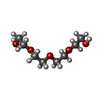 ChemComp-PG4: 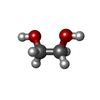 ChemComp-EDO:  ChemComp-FMT:  ChemComp-HOH: 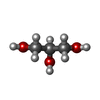 ChemComp-GOL:  ChemComp-AZI: |
| Source |
|
 Keywords Keywords | HYDROLASE / Protease / Metallopeptidase / Metzincin |


 thomasclavelia ramosa (bacteria)