[English] 日本語
Yorodumi Papers
- Database of articles cited by EMDB/PDB/SASBDB data -

+
Search query

Keywords
Structure methods
Author
Journal
IF

-
Structure paper

TitleMolecular mechanism of bacteriophage contraction structure of an S-layer-penetrating bacteriophage.
Journal, issue, pagesLife Sci Alliance, Vol. 8, Issue 6, Year 2025
Publish dateMar 26, 2025
AuthorsJason S Wilson / Louis-Charles Fortier / Robert P Fagan / Per A Bullough /
PubMed AbstractThe molecular details of phage tail contraction and bacterial cell envelope penetration remain poorly understood and are completely unknown for phages infecting bacteria enveloped by proteinaceous S- ...The molecular details of phage tail contraction and bacterial cell envelope penetration remain poorly understood and are completely unknown for phages infecting bacteria enveloped by proteinaceous S-layers. Here, we reveal the extended and contracted atomic structures of an intact contractile-tailed phage (φCD508) that binds to and penetrates the protective S-layer of the Gram-positive human pathogen The tail is unusually long (225 nm), and it is also notable that the tail contracts less than those studied in related contractile injection systems such as the model phage T4 (∼20% compared with ∼50%). Surprisingly, we find no evidence of auxiliary enzymatic domains that other phages exploit in cell wall penetration, suggesting that sufficient energy is released upon tail contraction to penetrate the S-layer and the thick cell wall without enzymatic activity. Instead, the unusually long tail length, which becomes more flexible upon contraction, likely contributes toward the required free energy release for envelope penetration.
External linksLife Sci Alliance / PubMed:40139691 / PubMed Central
MethodsEM (single particle) / EM (helical sym.)
Resolution2.64 - 4.11 Å
Structure data

EMDB-51138, PDB-9g8s:
C3 reconstruction of extended phiCD508 needle
Method: EM (single particle) / Resolution: 3.96 Å

EMDB-51191, PDB-9gay:
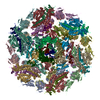
Extended phiCD508 capsid
Method: EM (single particle) / Resolution: 3.74 Å

EMDB-51192, PDB-9gaz:
Contracted phiCD508 capsid
Method: EM (single particle) / Resolution: 3.28 Å

EMDB-51193, PDB-9gb0:
Extended phiCD508 portal adjacent capsid
Method: EM (single particle) / Resolution: 3.23 Å

EMDB-51194, PDB-9gb1:
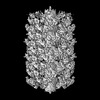
Extended phiCD508 tail
Method: EM (helical sym.) / Resolution: 2.71 Å

EMDB-51195, PDB-9gb2:
Extended phiCD508 baseplate
Method: EM (single particle) / Resolution: 3.43 Å

EMDB-51196, PDB-9gb3:
Extended phiCD508 portal
Method: EM (single particle) / Resolution: 2.64 Å

EMDB-51197, PDB-9gb4:
Contracted phiCD508 portal
Method: EM (single particle) / Resolution: 2.88 Å

EMDB-51198, PDB-9gb5:
Contracted phiCD508 neck
Method: EM (single particle) / Resolution: 3.27 Å

EMDB-51199, PDB-9gb6:
Contracted phiCD508 tail
Method: EM (helical sym.) / Resolution: 4.11 Å

EMDB-51200, PDB-9gb7:
Extended phiCD508 neck
Method: EM (single particle) / Resolution: 3.4 Å

EMDB-51201, PDB-9gb8:
Contracted phiCD508 tail
Method: EM (single particle) / Resolution: 4.11 Å

Chemicals

ChemComp-FE2:
Unknown entry

Source
  • clostridioides difficile (bacteria)
  • clostridioides phage phicd508 (virus)
KeywordsVIRUS / Bacteriophage / needle / baseplate / capsid / VIRAL PROTEIN / portal / neck

+
About Yorodumi Papers

-
News

-
Feb 9, 2022. New format data for meta-information of EMDB entries

New format data for meta-information of EMDB entries

  • Version 3 of the EMDB header file is now the official format.
  • The previous official version 1.9 will be removed from the archive.

Related info.:EMDB header

External links:wwPDB to switch to version 3 of the EMDB data model

-
Aug 12, 2020. Covid-19 info

Covid-19 info

URL: https://pdbj.org/emnavi/covid19.php

New page: Covid-19 featured information page in EM Navigator.

Related info.:Covid-19 info / Mar 5, 2020. Novel coronavirus structure data

+
Mar 5, 2020. Novel coronavirus structure data

Novel coronavirus structure data

Related info.:Yorodumi Speices / Aug 12, 2020. Covid-19 info

External links:COVID-19 featured content - PDBj / Molecule of the Month (242):Coronavirus Proteases

+
Jan 31, 2019. EMDB accession codes are about to change! (news from PDBe EMDB page)

EMDB accession codes are about to change! (news from PDBe EMDB page)

  • The allocation of 4 digits for EMDB accession codes will soon come to an end. Whilst these codes will remain in use, new EMDB accession codes will include an additional digit and will expand incrementally as the available range of codes is exhausted. The current 4-digit format prefixed with “EMD-” (i.e. EMD-XXXX) will advance to a 5-digit format (i.e. EMD-XXXXX), and so on. It is currently estimated that the 4-digit codes will be depleted around Spring 2019, at which point the 5-digit format will come into force.
  • The EM Navigator/Yorodumi systems omit the EMD- prefix.

Related info.:Q: What is EMD? / ID/Accession-code notation in Yorodumi/EM Navigator

External links:EMDB Accession Codes are Changing Soon! / Contact to PDBj

+
Jul 12, 2017. Major update of PDB

Major update of PDB

  • wwPDB released updated PDB data conforming to the new PDBx/mmCIF dictionary.
  • This is a major update changing the version number from 4 to 5, and with Remediation, in which all the entries are updated.
  • In this update, many items about electron microscopy experimental information are reorganized (e.g. em_software).
  • Now, EM Navigator and Yorodumi are based on the updated data.

External links:wwPDB Remediation / Enriched Model Files Conforming to OneDep Data Standards Now Available in the PDB FTP Archive

-
Yorodumi Papers

Database of articles cited by EMDB/PDB/SASBDB data

  • Database of articles cited by EMDB, PDB, and SASBDB entries
  • Using PubMed data

Related info.:EMDB / PDB / SASBDB / Yorodumi / EMN Papers / Changes in new EM Navigator and Yorodumi

Read more