[English] 日本語
Yorodumi Papers
- Database of articles cited by EMDB/PDB/SASBDB data -

+
Search query

Keywords
Structure methods
Author
Journal
IF

-
Structure paper

TitleStructural basis of TnsC oligomerization and transposase recruitment in type I-B CRISPR-associated transposons.
Journal, issue, pagesNucleic Acids Res, Vol. 53, Issue 5, Year 2025
Publish dateFeb 27, 2025
AuthorsGiada Finocchio / Irma Querques / Christelle Chanez / Katarzyna J Speichert / Martin Jinek /
PubMed AbstractCRISPR-associated transposon (CAST) systems employ CRISPR-Cas systems as RNA-directed targeting modules for site-specific transposon DNA insertion. Among them, type I CASTs rely on the coordinated ...CRISPR-associated transposon (CAST) systems employ CRISPR-Cas systems as RNA-directed targeting modules for site-specific transposon DNA insertion. Among them, type I CASTs rely on the coordinated action of the guide RNA-bound Cascade complex and the transposon proteins TniQ, TnsC, and TnsAB. The interaction between the transposase TnsAB and the ATPase TnsC is crucial for transposition activity, yet the underlying molecular details have remained elusive. Here, we investigate the type I-B CAST system from Peltigera membranacea cyanobiont. Cryo-electron microscopic structures of TnsC and its complex with the C-terminal region of TnsAB reveal that TnsC forms a heptameric ring that recruits TnsAB by interacting with its C-terminal tail. In vitro binding assays indicate that TnsAB exclusively interacts with the TnsC heptamer without inducing its disassembly, in contrast to type V-K CAST systems. Mutational analysis of key structural features corroborates the significance of TnsC multimerization and TnsB interaction for transposon activity in vivo. Altogether, these findings offer detailed structural and functional insights into the molecular mechanism of type I-B CAST, with the aim of facilitating their development as genome engineering tools.
External linksNucleic Acids Res / PubMed:40103227 / PubMed Central
MethodsEM (single particle)
Resolution3.2 - 4.47 Å
Structure data

EMDB-50932, PDB-9g0f:
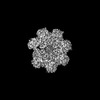
CryoEM structure of PmcTnsC-dsDNA-AMPPNP
Method: EM (single particle) / Resolution: 3.7 Å

EMDB-50933: CryoEM volume of a heptameric stretched ring conformation of the PmcTnsC-dsDNA-AMPPNP complex
Method: EM (single particle) / Resolution: 4.45 Å

EMDB-50934: CryoEM volume of an octameric stretched ring conformation of the PmcTnsC-dsDNA-AMPPNP complex
Method: EM (single particle) / Resolution: 4.47 Å

EMDB-51458, PDB-9gmz:
CryoEM structure of PmcTnsC-dsDNA-AMPPNP in complex with PmcTnsAB hook
Method: EM (single particle) / Resolution: 3.2 Å

Chemicals

ChemComp-ANP:
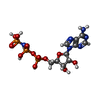
PHOSPHOAMINOPHOSPHONIC ACID-ADENYLATE ESTER / AMP-PNP, energy-carrying molecule analogue*YM

ChemComp-MG:
Unknown entry

Source
  • peltigera membranacea (fungus)
  • escherichia coli (E. coli)
KeywordsDNA BINDING PROTEIN / AAA+ ATPase / CRISPR / Tn7-like transposon / CAST / transposase / Integrase

+
About Yorodumi Papers

-
News

-
Feb 9, 2022. New format data for meta-information of EMDB entries

New format data for meta-information of EMDB entries

  • Version 3 of the EMDB header file is now the official format.
  • The previous official version 1.9 will be removed from the archive.

Related info.:EMDB header

External links:wwPDB to switch to version 3 of the EMDB data model

-
Aug 12, 2020. Covid-19 info

Covid-19 info

URL: https://pdbj.org/emnavi/covid19.php

New page: Covid-19 featured information page in EM Navigator.

Related info.:Covid-19 info / Mar 5, 2020. Novel coronavirus structure data

+
Mar 5, 2020. Novel coronavirus structure data

Novel coronavirus structure data

Related info.:Yorodumi Speices / Aug 12, 2020. Covid-19 info

External links:COVID-19 featured content - PDBj / Molecule of the Month (242):Coronavirus Proteases

+
Jan 31, 2019. EMDB accession codes are about to change! (news from PDBe EMDB page)

EMDB accession codes are about to change! (news from PDBe EMDB page)

  • The allocation of 4 digits for EMDB accession codes will soon come to an end. Whilst these codes will remain in use, new EMDB accession codes will include an additional digit and will expand incrementally as the available range of codes is exhausted. The current 4-digit format prefixed with “EMD-” (i.e. EMD-XXXX) will advance to a 5-digit format (i.e. EMD-XXXXX), and so on. It is currently estimated that the 4-digit codes will be depleted around Spring 2019, at which point the 5-digit format will come into force.
  • The EM Navigator/Yorodumi systems omit the EMD- prefix.

Related info.:Q: What is EMD? / ID/Accession-code notation in Yorodumi/EM Navigator

External links:EMDB Accession Codes are Changing Soon! / Contact to PDBj

+
Jul 12, 2017. Major update of PDB

Major update of PDB

  • wwPDB released updated PDB data conforming to the new PDBx/mmCIF dictionary.
  • This is a major update changing the version number from 4 to 5, and with Remediation, in which all the entries are updated.
  • In this update, many items about electron microscopy experimental information are reorganized (e.g. em_software).
  • Now, EM Navigator and Yorodumi are based on the updated data.

External links:wwPDB Remediation / Enriched Model Files Conforming to OneDep Data Standards Now Available in the PDB FTP Archive

-
Yorodumi Papers

Database of articles cited by EMDB/PDB/SASBDB data

  • Database of articles cited by EMDB, PDB, and SASBDB entries
  • Using PubMed data

Related info.:EMDB / PDB / SASBDB / Yorodumi / EMN Papers / Changes in new EM Navigator and Yorodumi

Read more