[English] 日本語
Yorodumi Papers
- Database of articles cited by EMDB/PDB/SASBDB data -

+
Search query

Keywords
Structure methods
Author
Journal
IF

-
Structure paper

TitleA DNA-gated molecular guard controls bacterial Hailong anti-phage defence.
Journal, issue, pagesNature, Vol. 643, Issue 8072, Page 794-800, Year 2025
Publish dateApr 30, 2025
AuthorsJoel M J Tan / Sarah Melamed / Joshua C Cofsky / Deepsing Syangtan / Samuel J Hobbs / Josefina Del Mármol / Marco Jost / Andrew C Kruse / Rotem Sorek / Philip J Kranzusch /
PubMed AbstractAnimal and bacterial cells use nucleotidyltransferase (NTase) enzymes to respond to viral infection and control major forms of immune signalling including cGAS-STING innate immunity and CBASS anti- ...Animal and bacterial cells use nucleotidyltransferase (NTase) enzymes to respond to viral infection and control major forms of immune signalling including cGAS-STING innate immunity and CBASS anti-phage defence. Here we discover a family of bacterial defence systems, which we name Hailong, that use NTase enzymes to constitutively synthesize DNA signals and guard against phage infection. Hailong protein B (HalB) is an NTase that converts deoxy-ATP into single-stranded DNA oligomers. A series of X-ray crystal structures define a stepwise mechanism of HalB DNA synthesis initiated by a C-terminal tyrosine residue that enables de novo enzymatic priming. We show that HalB DNA signals bind to and repress activation of a partnering Hailong protein A (HalA) effector complex. A 2.0-Å cryo-electron microscopy structure of the HalA-DNA complex reveals a membrane protein with a conserved ion channel domain and a unique crown domain that binds the DNA signal and gates activation. Analysing Hailong defence in vivo, we demonstrate that viral DNA exonucleases required for phage replication trigger release of the primed HalA complex and induce protective host cell growth arrest. Our results explain how inhibitory nucleotide immune signals can serve as molecular guards against phage infection and expand the mechanisms NTase enzymes use to control antiviral immunity.
External linksNature / PubMed:40306316 / PubMed Central
MethodsEM (single particle) / X-ray diffraction
Resolution1.88 - 2.41 Å
Structure data

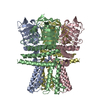
EMDB-49920: Structure of Hailong HalA in complex with oligodeoxyadenylate
PDB-9nyi: Structure of HalA in complex with oligodeoxyadenylate
Method: EM (single particle) / Resolution: 1.98 Å

PDB-9dbh:
Structure of Hailong HalB in complex with oligodeoxyadenylate
Method: X-RAY DIFFRACTION / Resolution: 1.88 Å

PDB-9dbi:
Structure of Hailong HalB D21A/D23A mutant
Method: X-RAY DIFFRACTION / Resolution: 1.99 Å

PDB-9dbj:
Structure of Hailong HalB R164A mutant with non-hydrolyzable dATP
Method: X-RAY DIFFRACTION / Resolution: 2.41 Å

Chemicals

ChemComp-MN:
Unknown entry

ChemComp-HOH:
WATER

ChemComp-PO4:
PHOSPHATE ION

PDB-1a3g:
BRANCHED-CHAIN AMINO ACID AMINOTRANSFERASE FROM ESCHERICHIA COLI

ChemComp-F2A:
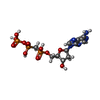
2'-deoxy-5'-O-[(S)-hydroxy{[(S)-hydroxy(phosphonooxy)phosphoryl]methyl}phosphoryl]adenosine

PDB-1a3h:
ENDOGLUCANASE CEL5A FROM BACILLUS AGARADHERANS AT 1.6A RESOLUTION

ChemComp-D5M:
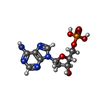
2'-DEOXYADENOSINE-5'-MONOPHOSPHATE

Source
  • rhodobacteraceae bacterium qy30 (bacteria)

  • dna molecule (others)
KeywordsANTIVIRAL PROTEIN/DNA / Hailong / nucleotidyltransferase / oligodeoxyadenylate / anti-phage defense / ANTIVIRAL PROTEIN / ANTIVIRAL PROTEIN-DNA complex / ion channel

+
About Yorodumi Papers

-
News

-
Feb 9, 2022. New format data for meta-information of EMDB entries

New format data for meta-information of EMDB entries

  • Version 3 of the EMDB header file is now the official format.
  • The previous official version 1.9 will be removed from the archive.

Related info.:EMDB header

External links:wwPDB to switch to version 3 of the EMDB data model

-
Aug 12, 2020. Covid-19 info

Covid-19 info

URL: https://pdbj.org/emnavi/covid19.php

New page: Covid-19 featured information page in EM Navigator.

Related info.:Covid-19 info / Mar 5, 2020. Novel coronavirus structure data

+
Mar 5, 2020. Novel coronavirus structure data

Novel coronavirus structure data

Related info.:Yorodumi Speices / Aug 12, 2020. Covid-19 info

External links:COVID-19 featured content - PDBj / Molecule of the Month (242):Coronavirus Proteases

+
Jan 31, 2019. EMDB accession codes are about to change! (news from PDBe EMDB page)

EMDB accession codes are about to change! (news from PDBe EMDB page)

  • The allocation of 4 digits for EMDB accession codes will soon come to an end. Whilst these codes will remain in use, new EMDB accession codes will include an additional digit and will expand incrementally as the available range of codes is exhausted. The current 4-digit format prefixed with “EMD-” (i.e. EMD-XXXX) will advance to a 5-digit format (i.e. EMD-XXXXX), and so on. It is currently estimated that the 4-digit codes will be depleted around Spring 2019, at which point the 5-digit format will come into force.
  • The EM Navigator/Yorodumi systems omit the EMD- prefix.

Related info.:Q: What is EMD? / ID/Accession-code notation in Yorodumi/EM Navigator

External links:EMDB Accession Codes are Changing Soon! / Contact to PDBj

+
Jul 12, 2017. Major update of PDB

Major update of PDB

  • wwPDB released updated PDB data conforming to the new PDBx/mmCIF dictionary.
  • This is a major update changing the version number from 4 to 5, and with Remediation, in which all the entries are updated.
  • In this update, many items about electron microscopy experimental information are reorganized (e.g. em_software).
  • Now, EM Navigator and Yorodumi are based on the updated data.

External links:wwPDB Remediation / Enriched Model Files Conforming to OneDep Data Standards Now Available in the PDB FTP Archive

-
Yorodumi Papers

Database of articles cited by EMDB/PDB/SASBDB data

  • Database of articles cited by EMDB, PDB, and SASBDB entries
  • Using PubMed data

Related info.:EMDB / PDB / SASBDB / Yorodumi / EMN Papers / Changes in new EM Navigator and Yorodumi

Read more