[English] 日本語
Yorodumi Papers
- Database of articles cited by EMDB/PDB/SASBDB data -

+
Search query

Keywords
Structure methods
Author
Journal
IF

-
Structure paper

TitleLoop-mediated regulation and base flipping drive RNA cleavage by human mitochondrial PNPase.
Journal, issue, pagesNucleic Acids Res, Vol. 53, Issue 22, Year 2025
Publish dateNov 26, 2025
AuthorsOle Unseld / Hrishikesh Das / B Martin Hällberg /
PubMed AbstractHuman polynucleotide phosphorylase (hPNPase), a trimeric exoribonuclease, is crucial for maintaining mitochondrial RNA metabolism, including the regulated degradation of RNA. Mutations in hPNPase ...Human polynucleotide phosphorylase (hPNPase), a trimeric exoribonuclease, is crucial for maintaining mitochondrial RNA metabolism, including the regulated degradation of RNA. Mutations in hPNPase have been linked to mitochondrial pathologies, underscoring its importance in mitochondrial RNA homeostasis. Despite this significance, the molecular basis of its catalytic mechanism and the structural consequences of active-site mutations remain poorly understood. We employed high-resolution electron cryo-microscopy to capture three distinct functional states of hPNPase during RNA degradation. In the loading state, flexible loops facilitate the recruitment of the substrate RNA and guide it toward the active site. During the pre-catalytic state, terminal nucleotides reorient within the active site, positioning the RNA backbone for cleavage, which is stabilized by Mg2+. Finally, the catalytic state reveals a nucleophilic attack of phosphate on the RNA backbone, mediated by key active-site residues. These results offer a clear biochemical framework for hPNPase-mediated RNA turnover, clarifying its catalytic mechanism and highlighting how active-site integrity is crucial for efficient RNA degradation.
External linksNucleic Acids Res / PubMed:41361968 / PubMed Central
MethodsEM (single particle)
Resolution2.08 - 2.65 Å
Structure data

EMDB-49478, PDB-9njb:
hPNPase RNA pre-catalytic state
Method: EM (single particle) / Resolution: 2.15 Å

EMDB-49479, PDB-9njc:
hPNPase bound to PO4 in loop conformation 1
Method: EM (single particle) / Resolution: 2.36 Å

EMDB-49480, PDB-9njd:
hPNPase bound to PO4 in loop conformation 3
Method: EM (single particle) / Resolution: 2.44 Å

EMDB-49481, PDB-9nje:
hPNPase bound to PO4 in loop conformation 2
Method: EM (single particle) / Resolution: 2.44 Å

EMDB-49590, PDB-9no0:
hPNPase RNA loading state
Method: EM (single particle) / Resolution: 2.08 Å

EMDB-72335, PDB-9xyi:
hPNPase RNA loading state
Method: EM (single particle) / Resolution: 2.46 Å

EMDB-72352, PDB-9xzf:
hPNPase RNA loading state with extended RNA in the bottom
Method: EM (single particle) / Resolution: 2.65 Å

Chemicals

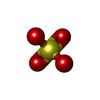
ChemComp-SO4:
SULFATE ION

ChemComp-MG:
Unknown entry

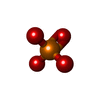
ChemComp-PO4:
PHOSPHATE ION

Source
  • homo sapiens (human)
KeywordsRNA BINDING PROTEIN/RNA / RNase / Protein-RNA Complex / RNA degradation / mitochondria / phosphorolytic enzyme / RNA BINDING PROTEIN / RNA BINDING PROTEIN-RNA complex / PO4 binding / TRANSFERASE/RNA / TRANSFERASE-RNA complex

+
About Yorodumi Papers

-
News

-
Feb 9, 2022. New format data for meta-information of EMDB entries

New format data for meta-information of EMDB entries

  • Version 3 of the EMDB header file is now the official format.
  • The previous official version 1.9 will be removed from the archive.

Related info.:EMDB header

External links:wwPDB to switch to version 3 of the EMDB data model

-
Aug 12, 2020. Covid-19 info

Covid-19 info

URL: https://pdbj.org/emnavi/covid19.php

New page: Covid-19 featured information page in EM Navigator.

Related info.:Covid-19 info / Mar 5, 2020. Novel coronavirus structure data

+
Mar 5, 2020. Novel coronavirus structure data

Novel coronavirus structure data

Related info.:Yorodumi Speices / Aug 12, 2020. Covid-19 info

External links:COVID-19 featured content - PDBj / Molecule of the Month (242):Coronavirus Proteases

+
Jan 31, 2019. EMDB accession codes are about to change! (news from PDBe EMDB page)

EMDB accession codes are about to change! (news from PDBe EMDB page)

  • The allocation of 4 digits for EMDB accession codes will soon come to an end. Whilst these codes will remain in use, new EMDB accession codes will include an additional digit and will expand incrementally as the available range of codes is exhausted. The current 4-digit format prefixed with “EMD-” (i.e. EMD-XXXX) will advance to a 5-digit format (i.e. EMD-XXXXX), and so on. It is currently estimated that the 4-digit codes will be depleted around Spring 2019, at which point the 5-digit format will come into force.
  • The EM Navigator/Yorodumi systems omit the EMD- prefix.

Related info.:Q: What is EMD? / ID/Accession-code notation in Yorodumi/EM Navigator

External links:EMDB Accession Codes are Changing Soon! / Contact to PDBj

+
Jul 12, 2017. Major update of PDB

Major update of PDB

  • wwPDB released updated PDB data conforming to the new PDBx/mmCIF dictionary.
  • This is a major update changing the version number from 4 to 5, and with Remediation, in which all the entries are updated.
  • In this update, many items about electron microscopy experimental information are reorganized (e.g. em_software).
  • Now, EM Navigator and Yorodumi are based on the updated data.

External links:wwPDB Remediation / Enriched Model Files Conforming to OneDep Data Standards Now Available in the PDB FTP Archive

-
Yorodumi Papers

Database of articles cited by EMDB/PDB/SASBDB data

  • Database of articles cited by EMDB, PDB, and SASBDB entries
  • Using PubMed data

Related info.:EMDB / PDB / SASBDB / Yorodumi / EMN Papers / Changes in new EM Navigator and Yorodumi

Read more