[English] 日本語
Yorodumi Papers
- Database of articles cited by EMDB/PDB/SASBDB data -

+
Search query

Keywords
Structure methods
Author
Journal
IF

-
Structure paper

TitleCryo-EM Structures of Apo and DDT-Bound P-Glycoprotein in Yellowfin Tuna.
Journal, issue, pagesEnviron Sci Technol, Vol. 59, Issue 22, Page 11251-11260, Year 2025
Publish dateJun 10, 2025
AuthorsMegan A Young / Steven D Rees / Sascha C T Nicklisch / Michael H B Stowell / Amro Hamdoun / Geoffrey Chang /
PubMed AbstractPersistent pollutants in the ocean impact the safety of seafood. Many emerging and legacy persistent organic pollutants (POPs) have been disposed into the world's oceans, exemplified by the recent ...Persistent pollutants in the ocean impact the safety of seafood. Many emerging and legacy persistent organic pollutants (POPs) have been disposed into the world's oceans, exemplified by the recent discovery of large amounts of the halogenated pesticide dichlorodiphenyltrichloroethane (DDT) waste in the waters of Southern California. The biological mechanisms governing persistence and trophic transfer of marine pollutants into seafood species remain incompletely understood. Xenobiotic transporters, such as P-glycoprotein (P-gp), are present in all organisms and prevent the accumulation of toxic chemicals. Our previous work has demonstrated that halogenated marine pollutants can act as inhibitors of human and murine P-gp transporters by interacting with their binding site and impeding transport. Using cryo-EM, we determined the molecular interactions of DDT with P-glycoprotein from yellowfin tuna (). The results reveal that the conformation of the transporter samples multiple degrees of widening in the absence of substrate. We also show that DDT binds in a singular, wide inward-facing conformation that could inhibit the transport cycle. This transporter inhibition may contribute to the bioaccumulation of DDT in tuna. This study highlights the capacity of persistent organic pollutants to act at multiple points in the food chain to inhibit this critical transport mechanism.
External linksEnviron Sci Technol / PubMed:40439033 / PubMed Central
MethodsEM (single particle)
Resolution3.79 - 4.02 Å
Structure data

EMDB-49366, PDB-9nfi:
Tuna P-glycoprotein Apo Conformation 1
Method: EM (single particle) / Resolution: 3.79 Å

EMDB-49367, PDB-9nfj:
Tuna P-glycoprotein Apo Conformation 2
Method: EM (single particle) / Resolution: 3.98 Å

EMDB-49368, PDB-9nfk:
Tuna P-glycoprotein Apo Conformation 3
Method: EM (single particle) / Resolution: 3.99 Å

EMDB-49369, PDB-9nfl:
Tuna P-glycoprotein Apo Conformation 4
Method: EM (single particle) / Resolution: 4.02 Å

EMDB-49370, PDB-9nfm:
Tuna P-glycoprotein bound to DDT
Method: EM (single particle) / Resolution: 3.89 Å

Chemicals

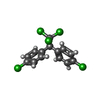
ChemComp-6WT:
1-chloranyl-4-[2,2,2-tris(chloranyl)-1-(4-chlorophenyl)ethyl]benzene

Source
  • thunnus albacares (yellowfin tuna)
KeywordsTRANSPORT PROTEIN / ABC Transporter / Membrane protein / Structural Genomics / PSI-Biology / Center for Structures of Membrane Proteins / CSMP

+
About Yorodumi Papers

-
News

-
Feb 9, 2022. New format data for meta-information of EMDB entries

New format data for meta-information of EMDB entries

  • Version 3 of the EMDB header file is now the official format.
  • The previous official version 1.9 will be removed from the archive.

Related info.:EMDB header

External links:wwPDB to switch to version 3 of the EMDB data model

-
Aug 12, 2020. Covid-19 info

Covid-19 info

URL: https://pdbj.org/emnavi/covid19.php

New page: Covid-19 featured information page in EM Navigator.

Related info.:Covid-19 info / Mar 5, 2020. Novel coronavirus structure data

+
Mar 5, 2020. Novel coronavirus structure data

Novel coronavirus structure data

Related info.:Yorodumi Speices / Aug 12, 2020. Covid-19 info

External links:COVID-19 featured content - PDBj / Molecule of the Month (242):Coronavirus Proteases

+
Jan 31, 2019. EMDB accession codes are about to change! (news from PDBe EMDB page)

EMDB accession codes are about to change! (news from PDBe EMDB page)

  • The allocation of 4 digits for EMDB accession codes will soon come to an end. Whilst these codes will remain in use, new EMDB accession codes will include an additional digit and will expand incrementally as the available range of codes is exhausted. The current 4-digit format prefixed with “EMD-” (i.e. EMD-XXXX) will advance to a 5-digit format (i.e. EMD-XXXXX), and so on. It is currently estimated that the 4-digit codes will be depleted around Spring 2019, at which point the 5-digit format will come into force.
  • The EM Navigator/Yorodumi systems omit the EMD- prefix.

Related info.:Q: What is EMD? / ID/Accession-code notation in Yorodumi/EM Navigator

External links:EMDB Accession Codes are Changing Soon! / Contact to PDBj

+
Jul 12, 2017. Major update of PDB

Major update of PDB

  • wwPDB released updated PDB data conforming to the new PDBx/mmCIF dictionary.
  • This is a major update changing the version number from 4 to 5, and with Remediation, in which all the entries are updated.
  • In this update, many items about electron microscopy experimental information are reorganized (e.g. em_software).
  • Now, EM Navigator and Yorodumi are based on the updated data.

External links:wwPDB Remediation / Enriched Model Files Conforming to OneDep Data Standards Now Available in the PDB FTP Archive

-
Yorodumi Papers

Database of articles cited by EMDB/PDB/SASBDB data

  • Database of articles cited by EMDB, PDB, and SASBDB entries
  • Using PubMed data

Related info.:EMDB / PDB / SASBDB / Yorodumi / EMN Papers / Changes in new EM Navigator and Yorodumi

Read more