[English] 日本語
Yorodumi Papers
- Database of articles cited by EMDB/PDB/SASBDB data -

+
Search query

Keywords
Structure methods
Author
Journal
IF

-
Structure paper

TitleHarnessing the Evolution of Proteostasis Networks to Reverse Cognitive Dysfunction.
Journal, issue, pagesbioRxiv, Year 2025
Publish dateMar 2, 2025
PubMed AbstractThe integrated stress response (ISR) is a highly conserved network essential for maintaining cellular homeostasis and cognitive function. Here, we investigated how persistent ISR activation impacts ...The integrated stress response (ISR) is a highly conserved network essential for maintaining cellular homeostasis and cognitive function. Here, we investigated how persistent ISR activation impacts cognitive performance, primarily focusing on a PPP1R15B genetic variant associated with intellectual disability. By generating a novel mouse model that mimics this human condition, we revealed that this variant destabilizes the PPP1R15B•PP1 phosphatase complex, resulting in chronic ISR activation, impaired protein synthesis, and deficits in long-term memory. Importantly, we found that the cognitive and synaptic deficits in mice are directly due to ISR activation. Leveraging insights from evolutionary biology, we characterized DP71L, a viral orthologue of PPP1R15B, through detailed molecular and structural analyses, uncovering its mechanism of action as a potent pan-ISR inhibitor. Remarkably, we found that DP71L not only buffers cognitive decline associated with a wide array of conditions-including Down syndrome, Alzheimer's disease and aging-but also enhances long-term synaptic plasticity and memory in healthy mice. These findings highlight the promise of utilizing evolutionary insight to inform innovative therapeutic strategies.
External linksbioRxiv / PubMed:40568171 / PubMed Central
MethodsEM (single particle)
Resolution3.03 - 3.8 Å
Structure data

EMDB-49124: Consensus reconstruction of the Dp71L-PP1A-eIF2alpha holophosphatase stabilized by G-actin/DNAseI
Method: EM (single particle) / Resolution: 3.03 Å

EMDB-49162: Focused refinement of G-actin within the Dp71L-PP1A-eIF2alpha-DNAseI-G-actin complex
Method: EM (single particle) / Resolution: 3.8 Å

EMDB-49163: Focused refinement of the Dp71L-eIF2alpha-PP1A subcomplex within the holo-phosphatase complex.
Method: EM (single particle) / Resolution: 3.8 Å

EMDB-49164: Focused refinement of DNAseI within the Dp71L-eIF2alpha-PP1A-Gactin-DNAseI holo-phosphatase complex.
Method: EM (single particle) / Resolution: 3.8 Å

EMDB-49223, PDB-9nb9:
Viral protein DP71L in complex with phosphorylated eIF2alpha (NTD) and protein phosphatase 1A (D64A), stabilized by G-actin/DNAseI
Method: EM (single particle) / Resolution: 3.03 Å

Chemicals

ChemComp-MN:
Unknown entry

ChemComp-CA:
Unknown entry

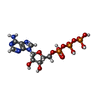
ChemComp-ATP:
ADENOSINE-5'-TRIPHOSPHATE / ATP, energy-carrying molecule*YM

Source
  • homo sapiens (human)
  • african swine fever virus
  • oryctolagus cuniculus (rabbit)
  • bos taurus (domestic cattle)
KeywordsTRANSLATION / Phosphatase / complex / ISR

+
About Yorodumi Papers

-
News

-
Feb 9, 2022. New format data for meta-information of EMDB entries

New format data for meta-information of EMDB entries

  • Version 3 of the EMDB header file is now the official format.
  • The previous official version 1.9 will be removed from the archive.

Related info.:EMDB header

External links:wwPDB to switch to version 3 of the EMDB data model

-
Aug 12, 2020. Covid-19 info

Covid-19 info

URL: https://pdbj.org/emnavi/covid19.php

New page: Covid-19 featured information page in EM Navigator.

Related info.:Covid-19 info / Mar 5, 2020. Novel coronavirus structure data

+
Mar 5, 2020. Novel coronavirus structure data

Novel coronavirus structure data

Related info.:Yorodumi Speices / Aug 12, 2020. Covid-19 info

External links:COVID-19 featured content - PDBj / Molecule of the Month (242):Coronavirus Proteases

+
Jan 31, 2019. EMDB accession codes are about to change! (news from PDBe EMDB page)

EMDB accession codes are about to change! (news from PDBe EMDB page)

  • The allocation of 4 digits for EMDB accession codes will soon come to an end. Whilst these codes will remain in use, new EMDB accession codes will include an additional digit and will expand incrementally as the available range of codes is exhausted. The current 4-digit format prefixed with “EMD-” (i.e. EMD-XXXX) will advance to a 5-digit format (i.e. EMD-XXXXX), and so on. It is currently estimated that the 4-digit codes will be depleted around Spring 2019, at which point the 5-digit format will come into force.
  • The EM Navigator/Yorodumi systems omit the EMD- prefix.

Related info.:Q: What is EMD? / ID/Accession-code notation in Yorodumi/EM Navigator

External links:EMDB Accession Codes are Changing Soon! / Contact to PDBj

+
Jul 12, 2017. Major update of PDB

Major update of PDB

  • wwPDB released updated PDB data conforming to the new PDBx/mmCIF dictionary.
  • This is a major update changing the version number from 4 to 5, and with Remediation, in which all the entries are updated.
  • In this update, many items about electron microscopy experimental information are reorganized (e.g. em_software).
  • Now, EM Navigator and Yorodumi are based on the updated data.

External links:wwPDB Remediation / Enriched Model Files Conforming to OneDep Data Standards Now Available in the PDB FTP Archive

-
Yorodumi Papers

Database of articles cited by EMDB/PDB/SASBDB data

  • Database of articles cited by EMDB, PDB, and SASBDB entries
  • Using PubMed data

Related info.:EMDB / PDB / SASBDB / Yorodumi / EMN Papers / Changes in new EM Navigator and Yorodumi

Read more